aecium
See also: æcium
English
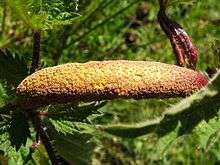
A gall of the fungus Puccinia urticata (nettle rust), covered with aecia
Alternative forms
Etymology
From New Latin, from Ancient Greek αἰκία (aikía, “injury, insult”). However Merriam-Webster relates that aecium is a back-formation from aecidium and is not related to the Greek aikía. The word aecium was "introduced as a substitute for aecidium by the Purdue University plant pathologist J. C. Arthur (1850-1942) in an effort to reform terminology for rust fungi; see Terminology of the Spore-Structures in the Uredinales, Botanical Gazette, vol. 39 (Mar., 1905), pp. 219-22." [1]
Pronunciation
- IPA(key): /ˈis.i.ʌm/
Noun
aecium (plural aecia or aeciums)
- (mycology) A cuplike fruiting structure of some parasitic fungi (rusts) that contains chains of aeciospores.
- 1932 August, Ralph Ulysses Cotter, Factors Affecting the Development of the Aecial Stage of Puccinia Graminis, US Dept of Agriculture, Technical Bulletin No. 314, page 29,
- The writer therefore made observations to determine the conditions under which the aecia open and discharge spores most readily.
- 2010, N. K. Soni, Vandana Soni, Fundamentals of Botany, Volume 1, page 127,
- The receptive hyphae with binucleate cells eventually form the basal cells of the aecium. […] Many cup-like structures, called aecia, appear on the lower surface of leaf.
- 2010, M. S. Patil, Anjali Patil, 16: The Rust Fungi: Systematics, Diseases and Their Management, Arun Arya, Analía Edith Perelló (editors), Management of Fungal Plant Pathogens, page 209,
- It is a heteroecious rust and its aecia are produced on species of Oxalis, namely O. stricta, according to Arthur (1929).
- 1932 August, Ralph Ulysses Cotter, Factors Affecting the Development of the Aecial Stage of Puccinia Graminis, US Dept of Agriculture, Technical Bulletin No. 314, page 29,
Related terms
See also
- pycnium
- ↑ listed in the online Merriam-Webster. Retrieved 4 June 2018.
This article is issued from
Wiktionary.
The text is licensed under Creative Commons - Attribution - Sharealike.
Additional terms may apply for the media files.