aconitum
See also: Aconitum
English
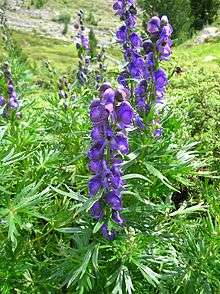
Acconitum napellus
Etymology
Noun
aconitum (plural aconitums)
- The poisonous herb aconite; also, an extract from it.
- c 1598 Shakespeare, Henry IV, Part 2, IV, iv
- Strong As aconitum or rash gunpowder.
- c 1598 Shakespeare, Henry IV, Part 2, IV, iv
- Aconitum, a genus of plants in the family Ranunculaceae.
Latin
Etymology
From Ancient Greek ἀκόνιτον (akóniton, “wolf's bane”).
Pronunciation
- (Classical) IPA(key): /a.koˈniː.tum/
Noun
aconītum n (genitive aconītī); second declension
- Any of the poisonous plants of the genus Aconitum; wolfsbane, monkshood, aconite.
- A poison made from the poisonous plants of the genus Aconitum.
Inflection
Second declension.
| Case | Singular | Plural |
|---|---|---|
| nominative | aconītum | aconīta |
| genitive | aconītī | aconītōrum |
| dative | aconītō | aconītīs |
| accusative | aconītum | aconīta |
| ablative | aconītō | aconītīs |
| vocative | aconītum | aconīta |
Descendants
References
- aconitum in Charlton T. Lewis and Charles Short (1879) A Latin Dictionary, Oxford: Clarendon Press
- aconitum in Charlton T. Lewis (1891) An Elementary Latin Dictionary, New York: Harper & Brothers
- aconitum in Gaffiot, Félix (1934) Dictionnaire Illustré Latin-Français, Hachette
This article is issued from
Wiktionary.
The text is licensed under Creative Commons - Attribution - Sharealike.
Additional terms may apply for the media files.