absinthe
English
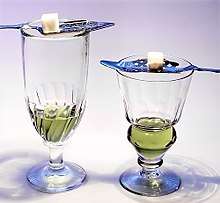
Glasses of absinthe with slotted spoons and sugar cubes.
Alternative forms
Etymology
French absinthe, from Latin absinthium, from Ancient Greek ἀψίνθιον (apsínthion, “wormwood”).
Pronunciation
- IPA(key): /ˈæb.sɪnθ/
Noun
absinthe (countable and uncountable, plural absinthes)
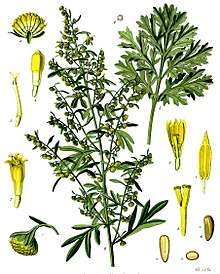
- The herb absinthium Artemisia absinthium (grande wormwood); essence of wormwood. [First attested around 1350 to 1470.][1]
- (figuratively) Bitterness; sorrow[1]. [First attested around 1350 to 1470.][1]
- A distilled, highly alcoholic, anise-flavored liquor originally made from grande wormwood, anise, and other herbs. [First attested in the mid 19th century.][1]
- A moderate yellow green; absinthe green. [First attested in the late 19th century.][1] absinthe green colour:
- (US) Sagebrush.
Usage notes
Synonyms
- (drink): green fairy (slang)
Derived terms
Translations
liquor
|
|
Artemisia absinthium
|
|
References
Anagrams
French
absinthe
Etymology
Borrowed from Latin absinthium.
Pronunciation
- IPA(key): /ap.sɛ̃t/
-
Audio (file) -
Audio (Paris) (file)
Noun
absinthe f (plural absinthes)
Further reading
- “absinthe” in le Trésor de la langue française informatisé (The Digitized Treasury of the French Language).
This article is issued from
Wiktionary.
The text is licensed under Creative Commons - Attribution - Sharealike.
Additional terms may apply for the media files.