Thule
See also: Thulé, Thulê, Thulē, and Thūlē
English
Alternative forms
- (with ού / ύ represented by u) Thule, Thulé, Thulê, Thulē, Thūlē, Tule [17th C.]
- (with ού / ύ represented by y) Thyle [17th C.], Thylé
- (with ού / ύ represented by ou) Thoule, Thoulê
Etymology
From the Middle English Tīle, Tȳle, from the Old English Tȳle, Thīla, Tīle (variants of Þȳle) and the Medieval Latin Tīle, from the Classical Latin Thūlē, Thȳlē, from the Ancient Greek Θούλη (Thoúlē), Θῡ́λη (Thū́lē), of unknown origin.[1]
Pronunciation 1
- (Received Pronunciation) IPA(key): /ˈθjuːliː/,[1] /ˈθuːliː/[2]
- (General American) IPA(key): /θuːl/, /ˈθjuːliː/[3]
- Rhymes: -uːliː, -uːl
Proper noun
Thule
- The semi-legendary island of classical antiquity considered to represent the northernmost location in the inhabited world (the Ecumene).
- 1844, Edgar Allan Poe, The Works of the Late Edgar Allan Poe II (1859), “Dream-Land”, page 41, first stanza, lines 5–6:
- I have reached these lands but newly // From an ultimate dim Thule.
- 1969, V.E. Watts (translator), Boëthius (author), The Consolation of Philosophy, bk III, ch. v, page 89:
- For distant India tremble may // Beneath your mighty rule, // And Thulé⁵ bow beneath your sway // Far in the Northern sea, // But if to care and want you’re prey, // No king are you, but slave.
- ibidem, footnote 5:
- 5. To the Romans Thulé, variously identified as Iceland or Mainland in the Shetland Isles, marked the extreme northern limit of the known world, just as India here stands for the farthest east.
- 1844, Edgar Allan Poe, The Works of the Late Edgar Allan Poe II (1859), “Dream-Land”, page 41, first stanza, lines 5–6:
- A nationalist and occultist group in Germany in the early twentieth century, which included some of the founding members of the Nazi Party.
- Short for "Ultima Thule" (Latin for "Last Thule"), the name of the fictional planet where the Space: 1999 episode "Death's Other Dominion" is set, so named by Terrestrials who were stranded there in 1986, unknowingly to any others.
Derived terms
Related terms
Pronunciation 2
- (Received Pronunciation) IPA(key): /θuːl/, /θjuːl/[4]
- (General American) IPA(key): /ˈtuːliː/[3]
- Rhymes: -uːliː, -uːl
Proper noun
Thule
Pronunciation 3
- (Received Pronunciation, General American) IPA(key): /ˈtuːliː/[3][4]
- Rhymes: -uːliː
Proper noun
Thule
- A settlement and airbase in northwestern Greenland established in 1910 by the Danish explorer Knud Rasmussen.
Translations
ancestors of the Canadian Inuit
the northernmost location of the ancient world
Further reading
-

References
- 1 2 Oxford English Dictionary, 2nd ed. "Thule". Oxford University Press (Oxford), 1989.
- ↑ Oxford Dictionaries. "ultima Thule". Oxford University Press (Oxford), 2015.
- 1 2 3 Oxford Dictionaries. "Thule" (American). Oxford University Press (Oxford), 2015.
- 1 2 Oxford Dictionaries. "Thule" (British). Oxford University Press (Oxford), 2015.
Anagrams
Latin
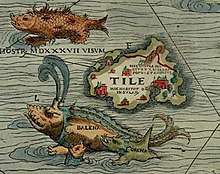
Thule with the alternative orthography Tile.
Etymology
From Ancient Greek Θούλη (Thoúlē, “Thule”)
Pronunciation
- (Classical) IPA(key): /ˈtʰuː.leː/, [ˈtʰuː.ɫeː]
Proper noun
Thūlē f (genitive Thūlēs); first declension
- a legenday northern island, Thule
- (Medieval Latin) Iceland
Inflection
First declension, Greek type.
| Case | Singular |
|---|---|
| nominative | Thūlē |
| genitive | Thūlēs |
| dative | Thūlae |
| accusative | Thūlēn |
| ablative | Thūlē |
| vocative | Thūlē |
References
- Thule in Charlton T. Lewis and Charles Short (1879) A Latin Dictionary, Oxford: Clarendon Press
This article is issued from
Wiktionary.
The text is licensed under Creative Commons - Attribution - Sharealike.
Additional terms may apply for the media files.