Tag
German

Pronunciation
- IPA(key): /tɑːk/ (Germany, Austria)
- IPA(key): /tax/ (northern Germany and parts of central Germany; often only colloquial for younger speakers)
- IPA(key): /tɑːx/ (parts of central Germany; Franconia, Lower Bavaria; often only colloquial for younger speakers)
- IPA(key): /tɑːɡ̊/ (Switzerland, Austria)
-
audio (Germany) (file) - Hyphenation: Tag
- Rhymes: -aːk, -ax, -aːx
Etymology 1
From Middle High German tag, tac, from Old High German tag, tac (attested since the 8th century); from Proto-Germanic *dagaz, from Proto-Indo-European *dʰegʷʰ- (“to burn, to be illuminated”).
Germanic cognates include Old Saxon dag (whence German Low German Dag), Old Dutch dag (whence Dutch dag, Afrikaans dag), Old English dæġ (whence Modern English day), West Frisian dei, Old Norse dagr (whence Icelandic dagur, Faroese dagur, Norwegian dag, Swedish dag, Danish dag) and Gothic 𐌳𐌰𐌲𐍃 (dags).
Non-Germanic cognates include Albanian djeg (“to burn”), Latin foveo (“to warm, nurture”), favilla (“cinders, ashes”), Ancient Greek τέφρα (téphra), Lithuanian dãgas (“hot season”), Russian жечь (žečʹ, “to burn”), Sanskrit दहति (dahati, “to burn”).
Although they are similar in appearance and meaning, German Tag and Proto-Germanic *dagaz are not related to Latin diēs as older folk etymology suggested; instead, the Latin word is derived from Proto-Indo-European *dyeu- *dyew- (“to shine”). See the Latvian diena (“day”) and Sanskrit दिन (diná, “day”) for more.[1]
Noun
Tag m (genitive Tages or Tags, plural Tage)
- a day; a period of time that lasts 24 hours
- a day; the period from midnight to the following midnight
- Der Tag fängt um Mitternacht an. — The day begins at midnight.
- a day; the period between sunrise and sunset when there is daylight
- Im Winter sind die Tage kürzer. — During the winter the days are shorter.
- Diese kurzen Tage verursachen Depressionen. — These short days cause feelings of depression.
- An den irdischen Polen dauert ein Tag sechs Monate — At the Earth's poles a day lasts about six months.
- (astronomy) a day, the rotational period of a planet, moon or any celestial body (especially Earth)
- the part of a day which one spends at work, school, etc
- Nun, wie war dein Tag? — Well, how was your day?
- Überstunden!? Was für ein Tag! — Overtime!? What a day!
- (idiomatic) a day; a specified time or period, considered with reference to the prominence or success (in life or in an an argument or conflict) of a person or thing
- Der Tag gehört uns. Gut gemacht, Männer! — It's our day, now. Well done, men!
- Heute ist einfach nicht mein Tag. — It's just not my day.
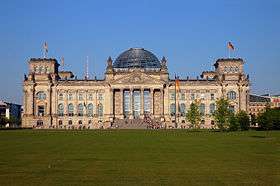
- (dated) a convention, a congress (now found chiefly in compounds such as Reichstag or Landtag)
Usage notes
- The plural Tage has a special meaning ("menstruation").
Declension
Hyponyms
Derived terms
- auf den Tag
- auf den Tag genau
- Geburtstag
- Glückstag
- Jüngster Tag
- Ruhetag
- Schalttag
- Schöpfungstag
- Stichtag
- Tagebau
- Tageblatt
- Tagebuch
- tagelang
- Tagelöhner
- Tagesausblick
- Tagesereignis
- Tagesnachrichten
- Tagesrückschau
- Tagesschau
- Tageszeitung
- täglich
- Tagtraum
- Tag und Nacht
- Weltgerichtstag
Related terms
Descendants
- Hunsrik: taach
See also
Etymology 2
Abbreviation of the greeting guten Tag (“good day”).
Interjection
Tag
References
- ↑ Wolfgang Pfeifer, Etymologisches Wörterbuch des Deutschen (1995, 2005; München: dtv; →ISBN
Polish
Proper noun
Tag m
- Tagus (river in Iberia)