Pinocchio
See also: pinocchio
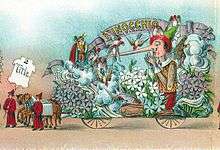
an illustration depicting the character Pinocchio
English
Etymology
Borrowed from Italian Pinocchio, possibly from the rare Tuscan form pinocchio (“pine nut”) or constructed from pino (“pine tree, pine wood”).
Pronunciation
Proper noun
Pinocchio
- The fictional boy made from wood whose nose gets longer with each lie he tells, protagonist of the story The Adventures of Pinocchio (1881) by Carlo Collodi.
- The popular fairy tale about Pinocchio.
Coordinate terms
Derived terms
Translations
protagonist
|
|
fairy tale
Noun
Pinocchio (plural Pinocchios)
Translations
one who lies often
|
|
one who has difficulty hiding lies
- The translations below need to be checked and inserted above into the appropriate translation tables, removing any numbers. Numbers do not necessarily match those in definitions. See instructions at Wiktionary:Entry layout#Translations.
Translations to be checked
|
Italian
Etymology
Possibly from the rare Tuscan form pinocchio (“pine nut”) or from pino (“pine tree, pine wood”) + -occhio.
Pronunciation
- IPA(key): /piˈnɔk.kjo/, [piˈnɔk̟ːjo]
- Rhymes: -ɔkkjo
- Hyphenation: Pi‧nòc‧chio
Proper noun
Pinocchio m
- Pinocchio (character and fairy tale)
Derived terms
- pinocchiesco
- pinocchietto
Portuguese
Proper noun
Pinocchio m
- Alternative spelling of Pinóquio
This article is issued from
Wiktionary.
The text is licensed under Creative Commons - Attribution - Sharealike.
Additional terms may apply for the media files.