Padus
Latin
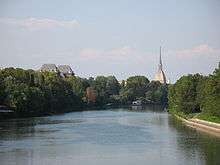
The Po along the city of Turin.
Etymology
From Ligurian Bodincus (“bottomless”), from Proto-Indo-European *bʰudʰmḗn. The name could have been borrowed through Ancient Greek Πάδος (Pádos).[1]
Pronunciation
- (Classical) IPA(key): /ˈpa.dus/, [ˈpa.dʊs]
Proper noun
Padus m (genitive Padī); second declension
- the River Po
Declension
Second declension, with locative.
| Case | Singular |
|---|---|
| nominative | Padus |
| genitive | Padī |
| dative | Padō |
| accusative | Padum |
| ablative | Padō |
| vocative | Pade |
| locative | Padī |
Synonyms
- (the River Po): Ēridanus (mythology, poetry)
Derived terms
- Padānus
- Padāneus
References
- Padus in William Smith, editor (1854, 1857) A Dictionary of Greek and Roman Geography, volume 1 & 2, London: Walton and Maberly
- Pădus in Charlton T. Lewis and Charles Short (1879) A Latin Dictionary, Oxford: Clarendon Press
- Padus in Harry Thurston Peck, editor (1898) Harper's Dictionary of Classical Antiquities, New York: Harper & Brothers
- Pădus in Gaffiot, Félix (1934) Dictionnaire Illustré Latin-Français, Hachette, page 1,101/2
- “Padus¹” on page 1,281/1 of the Oxford Latin Dictionary (1st ed., 1968–82)
- ↑ Keiler, Allan (1971): A reader in historical and comparative linguistics, p. 21
This article is issued from
Wiktionary.
The text is licensed under Creative Commons - Attribution - Sharealike.
Additional terms may apply for the media files.