鮟鱇
Chinese
| trad. (鮟鱇) | 鮟 | 鱇 | |
|---|---|---|---|
| simp. (𩽾𩾌) | 𩽾 | 𩾌 | |
Etymology
Borrowing from Japanese 鮟鱇 (ankō).
Pronunciation
Noun
鮟鱇
Synonyms
- 琵琶魚/琵琶鱼
- 老頭魚/老头鱼
Japanese
| Kanji in this term | |
|---|---|
| 鮟 | 鱇 |
| あん Hyōgaiji |
こう Hyōgaiji |
| on’yomi | |
Etymology
/anɡoː/ → /ankoː/
Unknown.
Various theories of the origin of あんこう (ankō) exist, such as from あんぐり (anguri) or あぐり (aguri, “agape, with one's mouth wide open”),[1][2] perhaps related to Korean 아귀 (agwi, “anglerfish”). The kanji spelling is an Edo-period coinage, found for example in the 1709 biology text 大和本草 (Yamato Honzō, “Japanese Biology”), formed from earlier ateji (当て字) 安康 (ankō) by adding the 魚 (“fish”) radical to each of the ateji characters. The current 鮟鱇 form has replaced the earlier 安康 form.
Pronunciation
Noun
鮟鱇 (hiragana あんこう, katakana アンコウ, rōmaji ankō, historical hiragana あんかう)
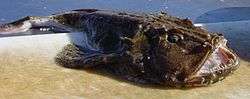
- an anglerfish, a monkfish, a goosefish
Usage notes
As with many terms that name organisms, this term is often spelled in katakana, especially in biological contexts, as アンコウ.
References
- ↑ フリーランス雑学ライダーズ編『あて字のおもしろ雑学』 p.47 1988年 永岡書店
- ↑ アンコウ: 語源, Japanese Wikipedia
- ↑ 2006, 大辞林 (Daijirin), Third Edition (in Japanese), Tōkyō: Sanseidō, →ISBN
- ↑ 1998, NHK日本語発音アクセント辞典 (NHK Japanese Pronunciation Accent Dictionary) (in Japanese), Tōkyō: NHK, →ISBN
- 1 2 1997, 新明解国語辞典 (Shin Meikai Kokugo Jiten), Fifth Edition (in Japanese), Tōkyō: Sanseidō, →ISBN
Korean
| Hanja in this term | |
|---|---|
| 鮟 | 鱇 |
Noun
鮟鱇 • (an-gang, McCune-Reischauer: an'gang, Yale: ankang) (hangeul 안강)
- Hanja form? of 안강 (“anglerfish; monkfish”).
Synonyms
- 아귀 (agwi)