高祖
Chinese
| high; tall | ancestor; forefather; grandparents | ||
|---|---|---|---|
| simp. and trad. (高祖) |
高 | 祖 | |
Pronunciation
- Mandarin
- (Standard Chinese)+
- Pinyin:
- Zhuyin: ㄍㄠ ㄗㄨˇ
- Gwoyeu Romatzyh: gautzuu
- IPA (key): /kɑʊ̯⁵⁵ t͡su²¹⁴⁻²¹⁽⁴⁾/
- (Standard Chinese)+
- Cantonese
- (Standard Cantonese, Guangzhou)+
- Jyutping: gou1 zou2
- Yale: gōu jóu
- Cantonese Pinyin: gou1 dzou2
- Guangdong Romanization: gou1 zou2
- IPA (key): /kou̯⁵⁵ t͡sou̯³⁵/
- (Standard Cantonese, Guangzhou)+
- Min Nan
- (Hokkien: Quanzhou)
- Pe̍h-ōe-jī: ko͘-chó͘
- Tâi-lô: koo-tsóo
- Phofsit Daibuun: kozor
- IPA (Quanzhou): /kɔ³³ t͡sɔ⁵⁵⁴/
- (Hokkien: mainstream Taiwanese, Xiamen, Zhangzhou)
- Pe̍h-ōe-jī: ko-chó͘
- Tâi-lô: ko-tsóo
- Phofsit Daibuun: koizor
- IPA (Taipei): /ko⁴⁴⁻³³ t͡sɔ⁵³/
- IPA (Kaohsiung): /kɤ⁴⁴⁻³³ t͡sɔ⁴¹/
- IPA (Xiamen, Zhangzhou): /ko⁴⁴⁻²² t͡sɔ⁵³/
- (Hokkien: Quanzhou)
Noun
高祖
Proper noun
高祖
- name given to the first emperor of some of the Chinese dynasties
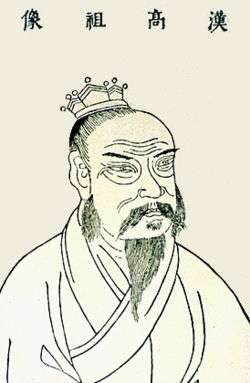
- Emperor Gaozu of Han (256 BC or 247 BC – June 1, 195 BC)
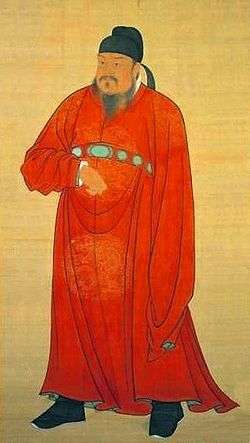
- Emperor Gaozu of Tang (566 – June 25, 635)
Synonyms
- 高皇 (Gāo Huáng)
This article is issued from
Wiktionary.
The text is licensed under Creative Commons - Attribution - Sharealike.
Additional terms may apply for the media files.