蜉蝣
Chinese
| Ephemera strigata | |||
|---|---|---|---|
| simp. and trad. (蜉蝣) |
蜉 | 蝣 | |
Pronunciation
- Mandarin
- (Standard Chinese)
- Pinyin:
- Zhuyin: ㄈㄨˊ ㄧㄡˊ
- Gwoyeu Romatzyh: fwuyou
- IPA (key): /fu³⁵ i̯oʊ̯³⁵/
- Homophones:
[Show/Hide] 浮游
蜉蝣
- (Standard Chinese)
- Cantonese
- (Standard Cantonese, Guangzhou)+
- Jyutping: fau4 jau4
- Yale: fàuh yàuh
- Cantonese Pinyin: fau4 jau4
- Guangdong Romanization: feo4 yeo4
- IPA (key): /fɐu̯²¹ jɐu̯²¹/
- (Standard Cantonese, Guangzhou)+
Noun
蜉蝣
Japanese
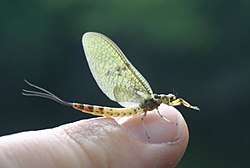
蜉蝣 (kagerō, fuyū): a mayfly.
Alternative forms
- 蜻蛉 (obsolete)
Etymology 1
| Kanji in this term | |
|---|---|
| 蜉 | 蝣 |
| Hyōgaiji | Hyōgaiji |
| Irregular | |
Change in meaning from 陽炎 (kagerō, “heat haze, heat shimmer”), from the way that the insects fly in swarms that visually resemble heat haze.[1] The kanji is jukujikun (熟字訓), from Chinese 蜉蝣.
Pronunciation
Noun
蜉蝣 (hiragana かげろう, katakana カゲロウ, rōmaji kagerō, historical hiragana かげろふ)
Usage notes
As with many terms that name organisms, this term is often spelled in katakana, especially in biological contexts, as カゲロウ.
Idioms
Etymology 2
| Kanji in this term | |
|---|---|
| 蜉 | 蝣 |
| Hyōgaiji | Hyōgaiji |
| Irregular | |
Change in meaning from 陽炎 (kagirō, “heat haze, heat shimmer”), from the way that the insects fly in swarms that visually resemble heat haze.[1]
Obsolete reading.
Noun
蜉蝣 (hiragana かぎろう, rōmaji kagirō, historical hiragana かぎろふ)
Etymology 3
| Kanji in this term | |
|---|---|
| 蜉 | 蝣 |
| ふ Hyōgaiji |
ゆう Hyōgaiji |
| on’yomi | |
From Middle Chinese 蜉蝣 (bjuw yuw?). Compare Mandarin 蜉蝣 (fúyóu), Vietnamese phù du.
Pronunciation
Noun
蜉蝣 (hiragana ふゆう, rōmaji fuyū, historical hiragana ふいう)
- a mayfly
- (by extension) ephemerality (from the way that mayflies are born and die within a day)
Idioms
References
This article is issued from
Wiktionary.
The text is licensed under Creative Commons - Attribution - Sharealike.
Additional terms may apply for the media files.