招き猫
Japanese
| Kanji in this term | |
|---|---|
| 招 | 猫 |
| まね Grade: 5 |
ねこ Grade: S |
| kun’yomi | |
Etymology
Compound of 招き (maneki, “beckoning, inviting”, continuative or stem of verb to beckon, to invite (maneku)) + 猫 (neko, “cat”).[1][2]
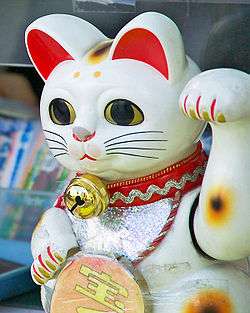
In Japanese culture, holding one's hand with the palm downwards and waving vertically is a gesture used to beckon someone. This is somewhat similar to an upside-down version of the beckoning gesture used in US culture. The way that cats will sometimes wave a front paw in the air is also similar to this Japanese beckoning gesture, giving rise to the iconic image of the maneki neko. This image is often used to beckon customers into a shop.
See the Wikipedia articles for more detail.
Pronunciation
Alternative forms
Noun
招き猫 (hiragana まねきねこ, rōmaji maneki neko)
Descendants
- Chinese: 招財貓
References
This article is issued from
Wiktionary.
The text is licensed under Creative Commons - Attribution - Sharealike.
Additional terms may apply for the media files.