⿺辶⿳穴⿲月⿱⿲幺言幺⿲長馬長刂心⿺辶⿳穴⿲月⿱⿲幺言幺⿲長馬長刂心麵
See also: ⿺辶⿳穴⿲月⿱⿲幺言幺⿲长马长刂心⿺辶⿳穴⿲月⿱⿲幺言幺⿲长马长刂心面
- The title of this entry appears incorrectly here because of technical limitations. The correct title is
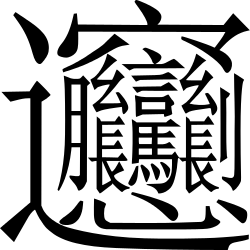
Chinese
FWOTD – 21 February 2016
| trad. | |
|---|---|
| simpl. | .svg.png) |
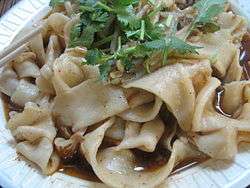
Biangbiang noodles
The character for "biáng", made up of 56 strokes, is one of the most complex Chinese characters in contemporary usage, although the character is not found in dictionaries and has not yet been added to Unicode.
Alternative forms
Etymology
Etymology uncertain. May be onomatopoeic in origin; from the sound of chewing biangbiang noodles or the sound made by the chef when pulling the dough and slapping it on the table.[1]
Pronunciation
- Mandarin
- (Standard Chinese)+
- Pinyin:
- Zhuyin: ㄅㄧㄤˊ ㄅㄧㄤˊ ㄇㄧㄢˋ
- Gwoyeu Romatzyh: byangbyangmiann
- IPA (key): /pi̯ɑŋ³⁵ pi̯ɑŋ³⁵ mi̯ɛn⁵¹/
- (Standard Chinese, erhua-ed)+
- Pinyin:
- Zhuyin: ㄅㄧㄤˊ ㄅㄧㄤˊㄦ ㄇㄧㄢˋ
- Gwoyeu Romatzyh: byangbyanglmiann
- IPA (key): /pi̯ɑŋ³⁵ pjɑ̃ɻ³⁵ mi̯ɛn⁵¹/
- (Standard Chinese)+
Noun
- biangbiang noodles, a type of thick noodle from China's Shaanxi province
Synonyms
References
- ↑ “China Daily: Biangbiang Shaanxi street food”, in (Please provide the title of the work), accessed 19 November 2012
This article is issued from
Wiktionary.
The text is licensed under Creative Commons - Attribution - Sharealike.
Additional terms may apply for the media files.