รัก
Thai
Pronunciation
| Orthographic/Phonemic | รัก r ạ k | |
| Romanization | Paiboon | rák |
| Royal Institute | rak | |
| (standard) IPA(key) | /rak̚˦˥/ | |
| Homophones | รักข์ รักษ์ | |
| Audio | ||
Etymology 1
From a Mon-Khmer language; ultimately from Proto-Mon-Khmer *r[a]k (“to love; beloved, dear”). Cognate with Northern Thai ᩁᩢ᩠ᨠ, Isan ฮัก, Lao ຮັກ (hak), Lü ᦣᧅ (hak), Shan ႁၵ်ႉ (hâ̰k), Tai Nüa ᥞᥐᥳ (hak5). Outside Tai-Kadai, cognate with Khmer រាក់ (rĕək, “friendly, cordial, pleasant; intimate, affectionate”), as in រាក់ទាក់ (reak-teak, “friendly, warm, pleasant”). The Proto-Mon-Khmer root possibly represents an allofam of the proto-root *mr[a]k, *rmr[a]k (compare Proto-Mon-Khmer *ma[a]k, *mak (“to like, love”)), whence Khmer ម្រក់ (mrŭək, “girl's friend of same sex, man's friend's wife”), and possibly Thai มลัก (má-lák, “to love, to like”).
Noun
รัก • (rák)
Verb
รัก • (rák) (abstract noun การรัก)
Etymology 2
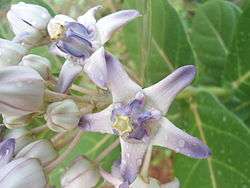
Cognate with Lao ຮັກ (hak). Compare Sanskrit आर्क (ārka, “crown flower”), Pali akka.
Noun
รัก • (rák)
- the plant Calotropis gigantea (L.) Aiton f. of the family Asclepiadaceae, commonly known in English as crown flower.
Etymology 3
From Proto-Tai *rakᴰ (“lacquer”). Compare Sanskrit लाक्षा (lākṣā, “a species of plant”).
Noun
รัก • (rák)
- the plant Gluta usitata (Wallich) Ding Hou of the family Anacardiaceae, commonly known in English as Burmese lacquer.