Περσεύς
Ancient Greek
Etymology
Uncertain. Some Proto-Indo-European origins have been proposed; more at Perseus.
Pronunciation
- (5th BCE Attic) IPA(key): /per.seú̯s/
- (1st CE Egyptian) IPA(key): /pɛrˈseʍs/
- (4th CE Koine) IPA(key): /perˈseɸs/
- (10th CE Byzantine) IPA(key): /perˈsefs/
- (15th CE Constantinopolitan) IPA(key): /perˈsefs/
Proper noun
Περσεύς • (Perseús) m (genitive Περσέως); third declension
- Perseus, a mythological figure
Inflection
Descendants
References
- Περσεύς in Liddell & Scott (1940) A Greek–English Lexicon, Oxford: Clarendon Press
- Περσεύς in Liddell & Scott (1889) An Intermediate Greek–English Lexicon, New York: Harper & Brothers
- Περσεύς in Autenrieth, Georg (1891) A Homeric Dictionary for Schools and Colleges, New York: Harper and Brothers
- Περσεύς in the Diccionario Griego–Español en línea (2006–2018)
- Περσεύς in Slater, William J. (1969) Lexicon to Pindar, Berlin: Walter de Gruyter
- Woodhouse, S. C. (1910) English–Greek Dictionary: A Vocabulary of the Attic Language, London: Routledge & Kegan Paul Limited, page 1,011
Greek
Περσεύς
Etymology
Unknown origin; see Perseus for details.
Pronunciation
- IPA(key): /perˈsefs/
- Hyphenation: Περ‧σεύς
Alternative forms
- Περσέας (Perséas)
Usage notes
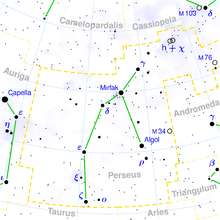
Περσέας (Perséas) is the standard Modern Greek form of the given name and the mythological character. Περσεύς (Perséfs), in Ancient Greek, is more commonly used when naming the constellation.
Proper noun
Περσεύς • (Perséfs) m
- (astronomy) Perseus the constellation between Andromeda and Auriga.
- (Greek mythology) Perseus the killer of Medusa.
Declension
This noun needs an inflection-table template.
This article is issued from
Wiktionary.
The text is licensed under Creative Commons - Attribution - Sharealike.
Additional terms may apply for the media files.