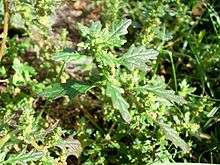
Dysphania pumilio
Taxonavigation
| Taxonavigation: Caryophyllales |
|---|
| Classification System: APG IV
Superregnum: Eukaryota |
Familia: Amaranthaceae s.l.
Cladus: Chenopodiaceae s.str.
Subfamilia: Chenopodioideae
Tribus: Dysphanieae
Genus: Dysphania
Sectio: Dysphania sect. Orthospora
Species: Dysphania pumilio
Name
Dysphania pumilio (R.Br.) Mosyakin & Clemants, Ukrayins'k. Bot. Zhurn. 59(4): 382. (2002)
Synonyms
- Basionym
- Chenopodium pumilio R.Br., Prodr. Fl. Nov. Holland. 407. (1810)
- Type: South Australia: Kangaroo Island, 1802-03-21, R. Brown #3033. Holotype: BM BM001010202. Syntype: MEL607120
- Chenopodium pumilio R.Br., Prodr. Fl. Nov. Holland. 407. (1810)
- Homotypic
- Ambrina pumilio (R.Br.) Moq., Chenop. Monogr. Enum. 42. (1840)
- Blitum pumilio (R.Br.) C.A.Mey. ex Steud., Nomencl. Bot. [Steudel], ed. 2. 1: 210. (1840)
- Teloxys pumilio (R.Br.) W.A.Weber, Phytologia 58(7): 478. (1985)
- Neobotrydium pumilio (R.Br.) M.L.Zhang & G.L.Chu, Pl. Diversity 38(6): 327. (2016)
- Neobotrydium pumilio (R.Br.) G.L.Chu, Gen. New Evol. System World Chenopod. 74. (2017), isonym
- Heterotypic
- Blitum glandulosum Moq., Prodr. [A. P. de Candolle] 13(2): 82. (1849)
- Type: "In Novâ-Hollandiâ. ... (v.s. in L. Desf., Poir., DC. et Webb.)"
- Lectotype: Australia: Nova Hollandia, R.L. Desfontaines #s.n. P00606458.
- Chenopodium glandulosum (Moq.) F.Muell., Fragm. (Mueller) 7(50): 11. (1869)
- Chenopodium pumilio f. glandulosum (Moq.) Aellen, Verh. Natur!. Ges. Basel 44: 315. (1933)
- Chenopodium pumilio var. oblongifolium J.M.Black, Fl. S. Australia (ed.2) 2: 289. (1948), nom. inval. (no Latin diagnosis)
- Blitum glandulosum Moq., Prodr. [A. P. de Candolle] 13(2): 82. (1849)
- Misapplied names
- "Chenopodium carinatum" R.Br.
Distribution
| Native distribution areas: |
|---|
widely introduced and naturalized References: Brummitt, R.K. 2001. TDGW – World Geographical Scheme for Recording Plant Distributions, 2nd Edition |
References
Primary references
- Aellen, P. 1933. Die Arten der Sect. Orthosporum der Gattung Chenopodium L. Verhandlungen der Naturforschenden Gesellschaft in Basel 44: 308–318. Reference page. : 315
- Black, J.M. 1948. Flora of South Australia. Part II, Casuarinaceae – Euphorbiaceae. (ed. 2). Adelaide, Govt. Printer. 521 p. Reference page. : 289
- Brown, R. 1810. Prodromus Florae Novae Hollandiae et Insulae Van Diemen. Londini, R.Taylor. BHL Reference page. : 407
- Moquin-Tandon, A. 1840. Chenopodearum Monographica Enumeratio. P.-J. Loss, Paris. BHL Reference page. : 42
- Moquin-Tandon, A. 1849. Salsolaceae. In: De Candolle, A.P. (ed.): Prodromus systematis naturalis regni vegetabilis 13(2): 41–219. Masson, Paris. BHL Reference page. : 82
- Mosyakin, S.L. & Clemants, S.E. 2002. New nomenclatural combinations in Dysphania R.Br. (Chenopodiaceae): taxa occurring in North America. Ukrayins'kyi Botanicnyi Zhurnal 59(4): 380–385. Reference page. : 382
- Mueller, F.v. 1869–1871. Fragmenta Phytographiae Australiae. Vol. 7. 166 pp. J. Ferres, Melbourne. BHL Reference page. : 11
- Steudel, E.Th. 1840. Nomenclator botanicus. Seu: synonymia plantarum universalis, enumerans ordine alphabetico nomina atque synonyma, tum generica tum specifica, et a Linnaeo et a recentioribus de re botanica scriptoribus plantis phanerogamis imposita. Editio secunda ex nova elaborata et aucta. Pars I: Lit. A–K. 852 pp. Typis et sumptibus J. G. Cottae, Stuttgartiae [Stuttgart] et Tubingae [Tübingen]. BHL Reference page. : 210
- Weber, W.A. 1985. The genus Teloxys (Chenopodiaceae). Phytologia 58(7): 477–478. BHL Reference page. : 478
- Zhang, M.L. & Chu, G.L. 2016. Resurrection of the genus Botrydium Spach (Chenopodiaceae), with a description of four new species from China, Peru and Burundi. Plant Diversity 38(6): 322-329. DOI: 10.1016/j.pld.2016.10.005 Reference page. : 327
- Zhu, G.L. & Sanderson, S.C. 2017. Genera and a New Evolutionary System of World Chenopodiaceae. 361 pp. Beijing: Science Press. Reference page. : 74
Additional references
- Clemants, S.E. & Mosyakin, S.L. 2003.
- eFloras 2008. Dysphania pumilio in Flora of North America . Missouri Botanical Garden, St. Louis, MO & Harvard University Herbaria, Cambridge, MA.
Links
- Australian Plant Name Index (APNI) 2016. Dysphania pumilio Integrated Botanical Information System (IBIS). Australian National Botanic Gardens & Australian National Herbarium. Accessed: 2016 Mar. 18.
- Hassler, M. 2018. Dysphania pumilio. World Plants: Synonymic Checklists of the Vascular Plants of the World (2019). In: Roskov Y., Abucay L., Orrell T., Nicolson D., Bailly N., Kirk P., Bourgoin T., DeWalt R.E., Decock W., De Wever A., Nieukerken E. van, Zarucchi, J., Penev L., eds. 2018. Species 2000 & ITIS Catalogue of Life. Published on the internet. Accessed: 2018 Nov. 27.
- International Plant Names Index. 2016. Dysphania pumilio. Published online. Accessed Mar. 18 2016.
- The Plant List 2013. Dysphania pumilio in The Plant List Version 1.1. Published on the internet. Accessed: 2016 Mar. 18.
- Tropicos.org 2016. Dysphania pumilio. Missouri Botanical Garden. Published on the internet. Accessed: 18 Mar. 2016.
Vernacular names
čeština: Merlík trpasličí
Cymraeg: Troed-yr-ŵydd Awstralia
Deutsch: Australischer Drüsengänsefuß, Australien-Drüsengänsefuß, Australischer Gänsefuß
English: clammy goosefoot, small crumbweed (Australia: Boggabri, Mintweed)
suomi: Australiansavikka
Nederlands: Liggende ganzenvoet
svenska: Pygmémålla
Cymraeg: Troed-yr-ŵydd Awstralia
Deutsch: Australischer Drüsengänsefuß, Australien-Drüsengänsefuß, Australischer Gänsefuß
English: clammy goosefoot, small crumbweed (Australia: Boggabri, Mintweed)
suomi: Australiansavikka
Nederlands: Liggende ganzenvoet
svenska: Pygmémålla
 |
For more multimedia, look at Dysphania pumilio on Wikimedia Commons. |
This article is issued from
Wikimedia.
The text is licensed under Creative
Commons - Attribution - Sharealike.
Additional terms may apply for the media files.