< Page:Optics.djvu
[1]
This page has been validated.
62
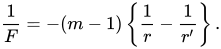
87. Now in the first place it will be immediately seen that this expression gives the principal focal distance, which we will call , by leaving out the last term, which is equivalent to making , or infinite: we have thus


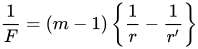
and then,
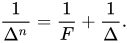
It appears from the former of these that is positive or negative according as is so: let us examine what sign this is affected with in different cases.

In the concavo-convex lens placed as in Fig. 86, and is positive.

When this lens is turned the contrary way, , but they are both negative, we have then

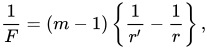
and is positive as before.
In the meniscus, either both being positive, and then

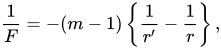
or , and both are negative: so that
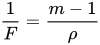
- ↑ It is often found convenient to put some symbol such as for which gives , or . When the radii are equal in a double concave or convex lens .




This article is issued from
Wikisource.
The text is licensed under Creative
Commons - Attribution - Sharealike.
Additional terms may apply for the media files.