The United States Geographic Board acts upon rules practically identical with those indicated, and compiles official lists of place-names, the use of which is binding upon government departments, but which it would hardly be wise to follow universally in the case of names of places outside America.
Measurement on Maps
Measurement of Distance.—The shortest distance between two places on the surface of a globe is represented by the arc of a great circle. If the two places are upon the same meridian or upon the equator the exact distance separating them is to be found by reference to a table giving the lengths of arcs of a meridian and of the equator. In all other cases recourse must be had to a map, a globe or mathematical formula. Measurements made on a topographical map yield the most satisfactory results. Even a general map may be trusted, as long as we keep within ten degrees of its centre. In the case of more considerable distances, however, a globe of suitable size should be consulted, or—and this seems preferable—they should be calculated by the rules of spherical trigonometry. The problem then resolves itself in the solution of a spherical triangle.
In the formulae which follow we suppose l and l′ to represent the latitudes, a and b the co-latitudes (90°−l or 90°−l′), and t the difference in longitude between them or the meridian distance, whilst D is the distance required.
If both places have the same latitude we have to deal with an isosceles triangle, of which two sides and the included angle are given. This triangle, for the convenience of calculation, we divide into two right-angled triangles. Then we have sin ½ D = sin a sin ½t, and since sin a = sin (90°−l) = cos t, it follows that
sin ½ D = cos l sin ½t.
If the latitudes differ, we have to solve an oblique-angled spherical triangle, of which two sides and the included angle are given. Thus,
cos t =
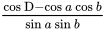
cos D | = cos a cos b + sin a sin b cos t |
= sin l sin l′ + cos l cos l′ cos t. | |
In order to adapt this formula to logarithms, we introduce a subsidiary angle p, such that cot p = cot l cos t; we then have
cos D = sin l cos (l′ − p) / sin p.
In the above formulae our earth is assumed to be a sphere, but when calculating and reducing to the sea-level, a base-line, or the side of a primary triangulation, account must be taken of the spheroidal shape of the earth and of the elevation above the sea-level. The error due to the neglect of the former would at most amount to 1%, while a reduction to the mean level of the sea necessitates but a trifling reduction, amounting, in the case of a base-line 100,000 metres in length, measured on a plateau of 3700 metres (12,000 ft.) in height, to 57 metres only.
These orthodromic distances are of course shorter than those measured along a loxodromic line, which intersects all parallels at the same angle. Thus the distance between New York and Oporto, following the former (great circle sailing), amounts to 3000 m., while following the rhumb, as in Mercator sailing, it would amount to 3120 m.
These direct distances may of course differ widely with the distance which it is necessary to travel between two places along a road, down a winding river or a sinuous coast-line. Thus, the direct distance, as the crow flies, between Brig and the hospice of the Simplon amounts to 4⋅42 geogr. m. (slope nearly 9°), while the distance by road measures 13⋅85 geogr. m. (slope nearly 3°). Distances such as these can be measured only on a topographical map of a fairly large scale, for on general maps many of the details needed for that purpose can no longer be represented. Space runners for facilitating these measurements, variously known as chartometers, curvimeters, opisometers, &c., have been devised in great variety. Nearly all these instruments register the revolution of a small wheel of known circumference, which is run along the line to be measured.
The Measurement of Areas is easily effected if the map at our disposal is drawn on an equal area projection. In that case we need simply cover the map with a network of squares—the area of each of which has been determined with reference to the scale of the map—count the squares, and estimate the contents of those only partially enclosed within the boundary, and the result will give the area desired. Instead of drawing these squares upon the map itself, they may be engraved or etched upon glass, or drawn upon transparent celluloid or tracing-paper. Still more expeditious is the use of a planimeter, such as Captain Prytz’s “Hatchet Planimeter,” which yields fairly accurate results, or G. Coradi’s “Polar Planimeter,” one of the most trustworthy instruments of the kind.[1]
When dealing with maps not drawn on an equal area projection we substitute quadrilaterals bounded by meridians and parallels, the areas for which are given in the “Smithsonian Geographical Tables” (1894), in Professor H. Wagner’s tables in the geographical Jahrbuch, or similar works.
It is obvious that the area of a group of mountains projected on a horizontal plane, such as is presented by a map, must differ widely from the area of the superficies or physical surface of those mountains exposed to the air. Thus, a slope of 45° having a surface of 100 sq. m. projected upon a horizontal plane only measures 59 sq. m., whilst 100 sq. m. of the snowclad Sentis in Appenzell are reduced to 10 sq. m. A hypsographical map affords the readiest solution of this question. Given the area A of the plane between the two horizontal contours, the height h of the upper above the lower contour, the length of the upper contour l, and the area of the face presented by the edge of the upper stratum l.h = A₁, the slope α is found to be tan α = h.l / (A − A₁); hence its superficies, A = A₂ sec α. The result is an approximation, for inequalities of the ground bounded by the two contours have not been considered.
The hypsographical map facilitates likewise the determination of the mean height of a country, and this height, combined with the area, the determination of volume, or cubic contents, is a simple matter.[2]
Relief Maps are intended to present a representation of the ground which shall be absolutely true to nature. The object, however, can be fully attained only if the scale of the map is sufficiently large, if the horizontal and vertical scales are identical, so that there shall be no exaggeration of the heights, and if regard is had, eventually, to the curvature of the earth’s surface. Relief maps on a small scale necessitate a generalization of the features of the ground, as in the case of ordinary maps, as likewise an exaggeration of the heights. Thus on a relief on a scale of 1:1,000,000 a mountain like Ben Nevis would only rise to a height of 1⋅3 mm.
- ↑ Professor Henrici, Report on Planimeters (64th meeting of the British Association, Oxford, 1894); J. Tennant, “The Planimeter” (Engineering, xlv. 1903).
- ↑ H. Wagner's Lehrbuch (Hanover, 1908, pp. 241-252) refers to numerous authorities who deal fully with the whole question of measurement.
- ↑ Kienzl of Leoben in 1891 had invented a similar apparatus which he called a Relief Pantograph (Zeitschrift, Vienna Geog. Soc. 1891).