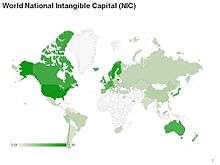
The geographical movement of money and commodities as capital is not the same as the movements of products and of precious metals. Capital is, after all, money used in a certain way, and is by no means identical with all money uses. ~ David Harvey
Capital is a factor of production, that is wanted for its ability to help in producing other goods. It is money or a financial asset invested for the purpose of making more money, whether in the form of profit, rent, interest, royalties, capital gain or some other kind of return.
B
- The primary capital to be safeguarded and valued is man, the human person in his or her integrity
- Pope Benedict XVI, Encyclical Letter Caritas in Veritate (29 June 2009), Chapter 25
H
- Massive concentration of financial power, accompanied by the machinations of finance capital, can as easily de-stabilize as stabilize capitalism.
- David Harvey (2006) The Limits To Capital Introduction, p. xxxii
- The geographical movement of money and commodities as capital is not the same as the movements of products and of precious metals. Capital is, after all, money used in a certain way, and is by no means identical with all money uses.
- David Harvey (2006) The Limits To Capital Chapter 12, Production Of Spatial Configurations, p. 376
L
- Labor is prior to, and independent of, capital. Capital is only the fruit of labor, and could never have existed if labor had not first existed. Labor is the superior of capital, and deserves much the higher consideration.
- Abraham Lincoln, First State of the Union Address (3 December 1861).
M
In bourgeois society capital is independent and has individuality, while the living person is dependent and has no individuality. ~ Karl Marx
- In general it may be said that demand is quite as necessary to the increase of capital as the increase of capital is to demand.
- Thomas Malthus (1836) Principles of Political Economy. Book II, Chapter I, On the Progress of Wealth, Section IV, p. 349 ( See also; Says Law)
- If one fourth of the capital of a country were suddenly destroyed, or entirely transferred to a different part of the world, without any other cause occurring of a diminished demand for commodities, this scantiness of capital would certainly occasion great inconvenience to consumers, and great distress among the working classes; but it would be attended with great advantages to the remaining capitalists.
- Thomas Malthus (1836) Principles of Political Economy. Book II, Chapter I, On The Progress of Wealth, Section X, p. 414
- In bourgeois society capital is independent and has individuality, while the living person is dependent and has no individuality.
- Karl Marx (1848), The Manifesto of the Communist Party
- Capital is money, capital is commodities. … By virtue of it being value, it has acquired the occult ability to add value to itself. It brings forth living offspring, or, at the least, lays golden eggs.
- Karl Marx (1867) Das Kapital, Vol. I, Ch. 4, pg.171 - 172
- Kapital ist tote Arbeit, die, vampirgleich, nur durch das Einsaugen lebendiger Arbeit lebt und die um so mehr lebt, je mehr lebendige Arbeit sie einsaugt.
- Capital is dead labor, that vampire-like, only lives by sucking living labor, and lives the more, the more labor it sucks.
- Karl Marx, Das Kapital, Vol. I, Ch. 10, Section 1, p. 257.
- Capitals accumulate faster than population.
- Karl Marx, Grundrisse, Notebook III, The Chapter on Capital, p. 271
- Capitalism is the condition of possessing capital; the position of a capitalist; a system which favours the existence of capitalists.
- James Murray and Henry Bradley, Philological Society (1933) Oxford English Dictionary. Vol 2. p. 94 Lemma "Capitalism"
R
- The produce of the earth - all that is derived from its surface by the united application of labour, machinery, and capital, is divided among three classes of the community, namely, the proprietor of the land, the owner of the stock or capital necessary for its cultivation, and the labourers by whose industry it is cultivated.
- David Ricardo (1821) The Principles of Political Economy and Taxation Original Preface, p. 1
- Population regulates itself by the funds which are to employ it, and therefore always increases or diminishes with the increase or the diminution of capital. Every reduction of capital is therefore necessarily followed by a less effective demand for corn, by a fall in price, and by diminished cultivation.
- David Ricardo (1821) The Principles of Political Economy and Taxation Chapter II, On Rent, p. 41
S
- People who originally have no means but are ultimately able to earn a great deal, through whatever talents they may possess, almost always come to think that these are permanent capital and that what they gain through them is interest. Accordingly, they do not put aside part of their earnings to form a permanent capital, but spend their money as fast as they earn it. But they are then often reduced to poverty because their earnings decrease or come to an end after their talent, which was of a transitory nature, is exhausted, as happens, for example, in the case of almost all the fine arts; or because it could be brought to bear only under a particular set of circumstances that has ceased to exist.
- Arthur Schopenhauer, “Aphorisms on the Wisdom of Life,” Parerga und Paralipomena, E. Payne, trans. (1974) Vol. 1, p. 348
- With artists and virtuosi of every kind, … what they earn should become their capital, whereas they recklessly regard it as mere interest and thus end in ruin. On the other hand, those who possess inherited wealth at least know at once and quite correctly what is capital and what is interest.
- Arthur Schopenhauer, “Aphorisms on the Wisdom of Life,” Parerga und Paralipomena, E. Payne, trans. (1974) Vol. 1, p. 348
- His capital is continually going from him in one shape, and returning to him in another, and it is only by means of such circulation, or successive exchanges, that it can yield him any profit. Such capitals, therefore, may very properly be called circulating capitals.
- Adam Smith (1776) The Wealth of Nations Book II Chapter I, p. 305
- No fixed capital can yield any revenue but by means of a circulating capital.
- Adam Smith (1776) The Wealth of Nations Book II Chapter I, p. 311
- It would be too ridiculous to go about seriously to prove that wealth does not consist in money, or in gold and silver; but in what money purchases, and is valuable only for purchasing. Money no doubt, makes always a part of the national capital; but it has already been shown that it generally makes but a small part, and always the most unprofitable part of it.
- Adam Smith (1776) The Wealth of Nations Book IV Chapter I, p. 470
W
- Labor in this country is independent and proud. It has not to ask the patronage of capital, but capital solicits the aid of labor.
- Daniel Webster, A discourse, delivered at Plymouth, December 22, 1820. In commemoration of the first settlement of New-England.
See also
External links
This article is issued from
Wikiquote.
The text is licensed under Creative
Commons - Attribution - Sharealike.
Additional terms may apply for the media files.