train wreck
See also: trainwreck and train-wreck
English
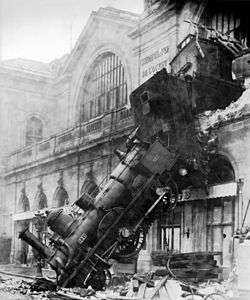
Train wreck at Montparnasse Station, Paris, France, 1895.
Alternative forms
Noun
train wreck (plural train wrecks)
- The aftermath of a train crash.
- (idiomatic) A disaster, especially one which is large in scale and readily seen by public observers.
- 1986, Hugh Sidey, "The Presidency: Colliding with Realities," Time, 1 Sept.:
- There is a feeling in Washington that we are gathering at the side of the track to watch a gigantic economic train wreck one of these days.
- 2007, Mel Odom, Blood Evidence, →ISBN, page 168:
- "Your personal life has been, and is, a train wreck."
- 2009, Matthue Roth, Never Mind The Goldbergs
- “Hrmm. I see your stylist's been working nights.” He surveyed the train wreck of my hair in the rearview mirror.
- 1986, Hugh Sidey, "The Presidency: Colliding with Realities," Time, 1 Sept.:
Usage notes
- In UK English, train crash is preferred for the literal sense, and car crash is more common but not exclusively used for the metaphorical sense.
Synonyms
- (literal train wreck): (hobo slang) prairie meet, (railroad jargon) cornfield meet
- (disaster): catastrophe
Translations
wreckage of a train crash
disaster
|
|
- The translations below need to be checked and inserted above into the appropriate translation tables, removing any numbers. Numbers do not necessarily match those in definitions. See instructions at Wiktionary:Entry layout#Translations.
Translations to be checked
|
References
- train wreck (slang): When the parts in an ensemble "collide" because the musicians are not playing together. Hal Leonard Pocket Music Dictionary, p. 122.
- Train wreck: in jazz, when everything comes off the rails - someone misses a repeat, skips the bridge, and so on. Dolmetsch Online.
- “train wreck” (US) / “train wreck” (UK) in Oxford Dictionaries, Oxford University Press.
This article is issued from
Wiktionary.
The text is licensed under Creative Commons - Attribution - Sharealike.
Additional terms may apply for the media files.