topiary
English
Etymology
From Latin topiarius (“of or relating to ornamental gardening; an ornamental garden, an ornamental gardener”), from Ancient Greek τόπια (tópia, “artistic representation in which natural or artificial features of a place are used as the medium”), from τόπος (tópos, “place”). The adjective use dates to 1592, the noun use dates to 1908.
Adjective
topiary (not comparable)
- Of, or relating to art of topiaries.
- 1910, American homes and gardens: Volume 7
- As the topiary art has been allowed to practically die out, it is difficult to secure the services of skilled clippers.
- 1910, American homes and gardens: Volume 7
- Of a tree or shrub, trimmed in artistic shape.
Translations
relating to the art of topiaries
|
trimmed in artistic shape
|
Noun
topiary (countable and uncountable, plural topiaries)
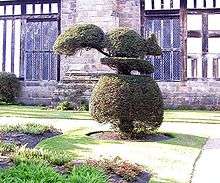
- (uncountable) Art or practice of trimming shrubs or trees in artistic or ornamental shapes, e.g. animals.
- 1994, Robert Jordan, Lord of Chaos, prologue
- The palace garden might have had a semblance of coolness had there been any trees, but the tallest things were fanciful topiary, tortured into the shapes of running horses or bears performing tumblers’ tricks or the like.
- 1994, Robert Jordan, Lord of Chaos, prologue
- (countable) A garden decorated with such art.
- (countable) One such shrub or tree.
- We have topiaries for sale.
-
Translations
art or practice
|
garden
shrub
|
|
See also
This article is issued from
Wiktionary.
The text is licensed under Creative Commons - Attribution - Sharealike.
Additional terms may apply for the media files.