pacifier
English
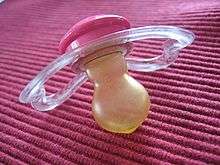
baby pacifier
Etymology
Noun
pacifier (plural pacifiers)
- Someone or something that pacifies. [from 16th c.]
- (Canada, US) A rubber or plastic device imitating a nipple that goes into a baby’s mouth, used to calm and quiet the baby. [from 20th c.]
Synonyms
(baby device):
Translations
one who pacifies
|
|
for a baby
|
|
Further reading
French
Etymology
From Latin pācificō, pācificāre, from pāx (“peace”).
Pronunciation
- IPA(key): /pa.si.fje/
Verb
pacifier
- to pacify
Conjugation
Conjugation of pacifier (see also Appendix:French verbs)
| simple | compound | ||||||
|---|---|---|---|---|---|---|---|
| infinitive | pacifier | avoir pacifié | |||||
| gerund | en pacifiant | en ayant pacifié | |||||
| present participle | pacifiant /pa.si.fjɑ̃/ | ||||||
| past participle | pacifié /pa.si.fje/ | ||||||
| person | singular | plural | |||||
| first | second | third | first | second | third | ||
| indicative | je (j’) | tu | il | nous | vous | ils | |
| simple tenses |
present | pacifie /pa.si.fi/ |
pacifies /pa.si.fi/ |
pacifie /pa.si.fi/ |
pacifions /pa.si.fjɔ̃/ |
pacifiez /pa.si.fje/ |
pacifient /pa.si.fi/ |
| imperfect | pacifiais /pa.si.fjɛ/ |
pacifiais /pa.si.fjɛ/ |
pacifiait /pa.si.fjɛ/ |
pacifiions /pa.si.fi.jɔ̃/ |
pacifiiez /pa.si.fi.je/ |
pacifiaient /pa.si.fjɛ/ | |
| past historic1 | pacifiai /pa.si.fje/ |
pacifias /pa.si.fja/ |
pacifia /pa.si.fja/ |
pacifiâmes /pa.si.fjam/ |
pacifiâtes /pa.si.fjat/ |
pacifièrent /pa.si.fjɛʁ/ | |
| future | pacifierai /pa.si.fi.ʁe/ |
pacifieras /pa.si.fi.ʁa/ |
pacifiera /pa.si.fi.ʁa/ |
pacifierons /pa.si.fi.ʁɔ̃/ |
pacifierez /pa.si.fi.ʁe/ |
pacifieront /pa.si.fi.ʁɔ̃/ | |
| conditional | pacifierais /pa.si.fi.ʁɛ/ |
pacifierais /pa.si.fi.ʁɛ/ |
pacifierait /pa.si.fi.ʁɛ/ |
pacifierions /pa.si.fi.ʁjɔ̃/ |
pacifieriez /pa.si.fi.ʁje/ |
pacifieraient /pa.si.fi.ʁɛ/ | |
| compound tenses |
present perfect | Use the present tense of avoir followed by the past participle | |||||
| pluperfect | Use the imperfect tense of avoir followed by the past participle | ||||||
| past anterior1 | Use the past historic tense of avoir followed by the past participle | ||||||
| future perfect | Use the future tense of avoir followed by the past participle | ||||||
| conditional perfect | Use the conditional tense of avoir followed by the past participle | ||||||
| subjunctive | que je (j’) | que tu | qu’il | que nous | que vous | qu’ils | |
| simple tenses |
present | pacifie /pa.si.fi/ |
pacifies /pa.si.fi/ |
pacifie /pa.si.fi/ |
pacifiions /pa.si.fi.jɔ̃/ |
pacifiiez /pa.si.fi.je/ |
pacifient /pa.si.fi/ |
| imperfect1 | pacifiasse /pa.si.fjas/ |
pacifiasses /pa.si.fjas/ |
pacifiât /pa.si.fja/ |
pacifiassions /pa.si.fja.sjɔ̃/ |
pacifiassiez /pa.si.fja.sje/ |
pacifiassent /pa.si.fjas/ | |
| compound tenses |
past | Use the present subjunctive tense of avoir followed by the past participle | |||||
| pluperfect1 | Use the imperfect subjunctive tense of avoir followed by the past participle | ||||||
| imperative | – | tu | – | nous | vous | – | |
| — | pacifie /pa.si.fi/ |
— | pacifions /pa.si.fjɔ̃/ |
pacifiez /pa.si.fje/ |
— | ||
| 1literary tenses | |||||||
Further reading
- “pacifier” in le Trésor de la langue française informatisé (The Digitized Treasury of the French Language).
This article is issued from
Wiktionary.
The text is licensed under Creative Commons - Attribution - Sharealike.
Additional terms may apply for the media files.