lilium
See also: Lilium
Latin
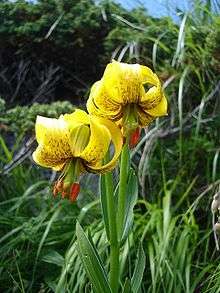
līlium (a lily)
Etymology
From Ancient Greek λείριον (leírion), probably a corrupted pronunciation of an Egyptian word. Perhaps also the root of Sanskrit हली (halī), हलिनी (halinī, “lily”).
Pronunciation
- (Classical) IPA(key): /ˈliː.li.um/, [ˈliː.li.ũ]
Noun
līlium n (genitive līliī); second declension
- a lily
Inflection
Second declension.
| Case | Singular | Plural |
|---|---|---|
| nominative | līlium | līlia |
| genitive | līliī | līliōrum |
| dative | līliō | līliīs |
| accusative | līlium | līlia |
| ablative | līliō | līliīs |
| vocative | līlium | līlia |
Related terms
Descendants
References
- lilium in Charlton T. Lewis and Charles Short (1879) A Latin Dictionary, Oxford: Clarendon Press
- lilium in Charlton T. Lewis (1891) An Elementary Latin Dictionary, New York: Harper & Brothers
- lilium in Charles du Fresne du Cange’s Glossarium Mediæ et Infimæ Latinitatis (augmented edition, 1883–1887)
- lilium in Gaffiot, Félix (1934) Dictionnaire Illustré Latin-Français, Hachette
This article is issued from
Wiktionary.
The text is licensed under Creative Commons - Attribution - Sharealike.
Additional terms may apply for the media files.