graph
English
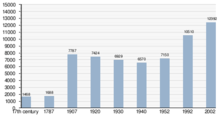
a demographic graph.
Etymology
Pronunciation
- (Received Pronunciation) IPA(key): /ɡɹɑːf/
- (US, Northern England) IPA(key): /ɡɹæf/
Audio (US) (file) - Rhymes: -ɑːf, -æf
Noun
graph (plural graphs)
- in the common language
- A diagram displaying data; in particular one showing the relationship between two or more quantities, measurements or indicative numbers that may or may not have a specific mathematical formula relating them to each other.
- 2012 March 1, Brian Hayes, “Pixels or Perish”, in American Scientist, volume 100, number 2, page 106:
- Drawings and pictures are more than mere ornaments in scientific discourse. Blackboard sketches, geological maps, diagrams of molecular structure, astronomical photographs, MRI images, the many varieties of statistical charts and graphs: These pictorial devices are indispensable tools for presenting evidence, for explaining a theory, for telling a story.
-
- A diagram displaying data; in particular one showing the relationship between two or more quantities, measurements or indicative numbers that may or may not have a specific mathematical formula relating them to each other.
- in mathematics
- (mathematics) A diagram displaying data, in particular one showing the relationship between two or more variables; specifically, for a function , the set of all tuples .
- (graph theory) An ordered pair
, where
is a set of elements called vertices (or nodes) and
is a set of pairs of elements of
, called edges; informally, a set of vertices together with a set edges that join these vertices.
- Hyponyms: tree, undirected graph
- (category theory) Said to be of a morphism f: a morphism from the domain of f to the product of the domain and codomain of f, such that the first projection applied to equals the identity of the domain, and the second projection applied to is equal to f.
- in linguistics
- (linguistics, typography) A graphical unit on the token-level, the abstracted fundamental shape of a character or letter as distinct from its ductus (realization in a particular typeface or handwriting on the instance-level) and as distinct by a grapheme on the type-level by not fundamentally distinguishing meaning.
- 2003, J. Richard Andrews, Introduction to Classical Nahuatl, Revised Edition, University of Oklahoma Press, page 10:
- A graph is a token-level nondistinctive representation of a grapheme. It can differ from the other variants of its grapheme with regard to upper case, lower case, script, print, typeface style, typeface size, etc.
- Synonym: glyph
-
- (linguistics, typography) A graphical unit on the token-level, the abstracted fundamental shape of a character or letter as distinct from its ductus (realization in a particular typeface or handwriting on the instance-level) and as distinct by a grapheme on the type-level by not fundamentally distinguishing meaning.




Hyponyms
Derived terms
|
|
|
|
- See also Thesaurus:graph
Derived terms
Derived terms
|
|
|
|
Related terms
Translations
mathematical diagram
|
|
an ordered pair in graph theory
|
|
Verb
graph (third-person singular simple present graphs, present participle graphing, simple past and past participle graphed)
- (transitive) To draw a graph.
- (transitive, mathematics) To draw a graph of a function.
Synonyms
Translations
See also
Anagrams
This article is issued from
Wiktionary.
The text is licensed under Creative Commons - Attribution - Sharealike.
Additional terms may apply for the media files.