endorheic
English
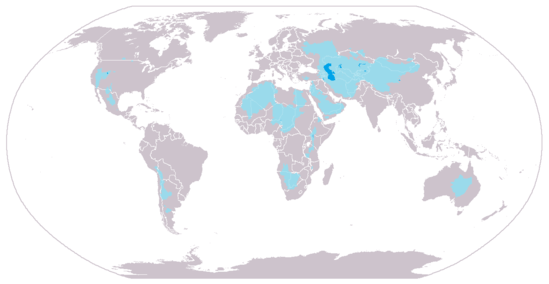
Major endorheic basins (in blue, with major endorheic lakes in dark blue).
Alternative forms
Etymology
From endo- (“internal”) + Ancient Greek ῥέω (rhéō, “I flow, stream”) + -ic.
Pronunciation
- (US) IPA(key): /ɛn.doʊˈɹi.ɪk/
Adjective
endorheic (not comparable)
- (of a lake or basin) Internally drained; having no outlet.
- 1937, Collected Papers - Osborn Zoological Society, Volume 19, Yale University, page 94,
- On the other hand all closed lakes of the kind now being considered must lie in endorheic regions.
- 1998, Brian Moss, Ecology of Fresh Waters: Man and Medium, Past to Future, Third Edition, Blackwell Publishing, →ISBN, page 198,
- The catchment-derived water-supply, in evaporating, leaves salts and the basin becomes an endorheic (internally drained) salt lake.
- 2012, Yeqiao Wang, ed., Remote Sensing of Protected Lands, CRC Press, →ISBN, page 318,
- Tibetan lakes in the endorheic basins are dynamic and sensitive to climate change.
- 2012 January 1, Douglas Larson, “Runaway Devils Lake”, in American Scientist, volume 100, number 1, page 46:
- Devils Lake is where I began my career as a limnologist in 1964, studying the lake’s neotenic salamanders and chironomids, or midge flies. […] The Devils Lake Basin is an endorheic, or closed, basin covering about 9,800 square kilometers in northeastern North Dakota.
- 1937, Collected Papers - Osborn Zoological Society, Volume 19, Yale University, page 94,
Synonyms
Antonyms
- (internally drained): exorheic
Translations
internally drained; having no outlet
|
|
See also

Anagrams
This article is issued from
Wiktionary.
The text is licensed under Creative Commons - Attribution - Sharealike.
Additional terms may apply for the media files.