cytisus
See also: Cytisus
English
Etymology
From Ancient Greek κύτισος (kútisos), of unknown origin.
Noun
cytisus (plural cytisuses)
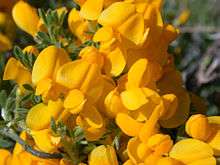
- Any flowering plant in the genus Cytisus.
- 1873, Ivan Sergeevich Turgenev, Liza:
- His head leaning back on the cushions, his arms folded across his breast, Lavretsky gazed at the furrowed plains which opened fanwise before him, at the cytisus shrubs, at the crows and rooks which looked sideways at the passing carriage with dull suspicion, at the long ridges planted with mugwort, wormwood, and mountain ash.
Translations
plant in Cytisus
|
Further reading



Latin
Etymology
Borrowed from Ancient Greek κύτισος (kútisos).
Pronunciation
- (Classical) IPA(key): /ˈky.ti.sus/, [ˈkʏ.tɪ.sʊs]
Noun
cytisus m (genitive cytisī); second declension
- a kind of clover
Inflection
Second declension.
| Case | Singular | Plural |
|---|---|---|
| nominative | cytisus | cytisī |
| genitive | cytisī | cytisōrum |
| dative | cytisō | cytisīs |
| accusative | cytisum | cytisōs |
| ablative | cytisō | cytisīs |
| vocative | cytise | cytisī |
References
- cytisus in Charlton T. Lewis and Charles Short (1879) A Latin Dictionary, Oxford: Clarendon Press
- cytisus in Gaffiot, Félix (1934) Dictionnaire Illustré Latin-Français, Hachette
This article is issued from
Wiktionary.
The text is licensed under Creative Commons - Attribution - Sharealike.
Additional terms may apply for the media files.