catheter
See also: cathéter
English
WOTD – 23 June 2018
Etymology
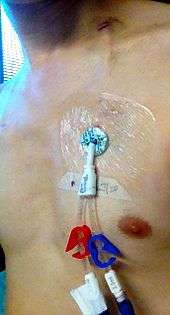
A Hickman line, a central venous catheter used when long-term intravenous access is required for chemotherapy, dialysis, or other uses
Borrowed from French cathéter, from Ancient Greek καθετήρ (kathetḗr, “surgical instrument for emptying the bladder”), from καθίημι (kathíēmi, “to descend, let down”) + -τήρ (-tḗr, “suffix forming masculine nouns from verbs”).
Pronunciation
- (Received Pronunciation) IPA(key): /ˈkæθɪtə(ɹ)/
- (General American) IPA(key): /ˈkæθɪt̬ɚ/
- Hyphenation: ca‧the‧ter
Noun
catheter (plural catheters)
- (medicine) A small tube inserted into a body cavity to administer a drug, create an opening, distend a passageway, or remove fluid.
- 1739, Archibald Cleland, “A Description of a Catheter, Made to Remedy the Inconveniencies Which Occasioned the Leaving off the High Operation for the Stone”, in Philosophical Transactions, volume 41, page 844:
- And I humbly hope, that the Description, and the Method of using this Catheter, will be a means of reviving a operation so happily begun, and calculated for the Good of those that are afflicted with the Stone in the Bladder.
-
Hyponyms
Derived terms
Terms derived from catheter
Translations
small tube inserted into a body cavity
|
|
Further reading

Anagrams
Dutch
Pronunciation
(file) - Hyphenation: ca‧the‧ter
Noun
catheter m (plural catheters, diminutive cathetertje n)
- superseded spelling of katheter.
Usage notes
- The spelling catheter was deprecated in 1996 in the new Groene Boekje (“Little Green Book”) spelling reform.
Derived terms
- catheterisatie
Portuguese
Noun
catheter m (plural catheteres)
- Obsolete spelling of cateter (used in Portugal until September 1911 and died out in Brazil during the 1920s).
This article is issued from
Wiktionary.
The text is licensed under Creative Commons - Attribution - Sharealike.
Additional terms may apply for the media files.