나비
Korean
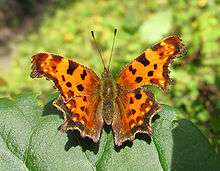
나비
Etymology
First attested in the Neungeomgyeong eonhae (楞嚴經諺解 / 능엄경언해), 1461, as Middle Korean 나ᄇᆡ (napoy). From a root *nAp meaning "flat, wide", represented in the modern language by 넓— (neol, “wide”) (< Middle Korean nep-). Also derived from this root are 나방 (nabang, “moth”) and 넙치 (neopchi, “flatfish”). A similar derivation is seen in Chinese 蝴蝶 (húdié), see there for more.
Pronunciation
- IPA(key)[na̠bi]
- Phonetic Hangul[나비]
|
Noun
나비 • (nabi)
Related terms
- 나방 (nabang, “moth”)
See also
- 고양이 (goyang-i)
This article is issued from
Wiktionary.
The text is licensed under Creative Commons - Attribution - Sharealike.
Additional terms may apply for the media files.