ヴ
| ||||||||||
Japanese
| Stroke order | |||
|---|---|---|---|
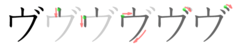 | |||
Etymology
Pronunciation
- IPA(key): [bɯ̟ᵝ]
Syllable
ヴ (romaji vu)
- The katakana syllable ヴ (vu). Its equivalent in hiragana is ゔ (vu).
Usage notes
- Unlike the hiragana system, used for Japanese language words that kanji does not cover, the katakana syllabary is used primarily for transcription of foreign language words into Japanese and the writing of loan words (collectively gairaigo), as well as to represent onomatopoeias, technical and scientific terms, and the names of plants, animals, and minerals. Names of Japanese companies, as well as certain Japanese language words, are also sometimes written in katakana rather than the other systems. Formerly, female given names were written in katakana. [edit]
- This is a relatively recent addition to kana usage to represent the non-native sound vu. As such, this is only found in borrowed words. Many speakers, especially older people, may pronounce this more as /bu/, [bɯᵝ].
See also
This article is issued from
Wiktionary.
The text is licensed under Creative Commons - Attribution - Sharealike.
Additional terms may apply for the media files.