กราบ
Thai
Pronunciation
| Orthographic | กราบ k r ā ɓ | |
| Phonemic | กฺราบ k ̥ r ā ɓ | |
| Romanization | Paiboon | gràap |
| Royal Institute | krap | |
| (standard) IPA(key) | /kraːp̚˨˩/ | |
Etymology 1
From Old Khmer krāpa, krāppa, krâppa (“to lower oneself to the ground in token of submission: to crouch, to squat, to prostrate oneself, etc; to show submission, respect, or reverence; to be submissive, respectful, or reverent; etc”). Cognate with Modern Khmer ក្រាប (kraap). Extended as Thai กำราบ (gam-ràap).
Verb
กราบ • (gràap) (abstract noun การกราบ)
Adverb
กราบ • (gràap)
- with deep submission, respect, or reverence as if performing prostration.
Usage notes
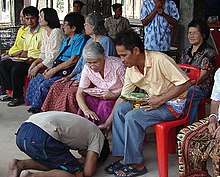
A man prostrates himself before his parents.
- In the Thai culture, prostration is performed by kneeling on the floor, folding one's legs underneath one's thighs, resting the buttocks on the heels, pressing one's palms together in a prayer-like fashion, and then bowing down until the forehead touches the ground or any other place, such as the lap or feet of the person for whom submission, respect, or reverence is intended.
- If prostration is performed with the five bodily organs – both knees, both palms, and the forehead – touching the ground, it is called เบญจางคประดิษฐ์, signifying deepest submission, respect, or reverence.
Derived terms
Derived terms
|
|
Related terms
Etymology 2
Uncertain.
Verb
กราบ • (gràap) (abstract noun การกราบ)
Etymology 3
Preposition
กราบ • (gràap)
- Archaic form of ตราบ (dtràap).
Conjunction
กราบ • (gràap)
- Archaic form of ตราบ (dtràap).
Etymology 4
Uncertain.
Noun
กราบ • (gràap)
Derived terms
Derived terms
|
This article is issued from
Wiktionary.
The text is licensed under Creative Commons - Attribution - Sharealike.
Additional terms may apply for the media files.