γυνή
Ancient Greek
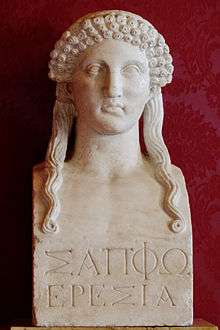
Ἡ γυνὴ καλέεται Σαπφὼ Λέσϐου.
Alternative forms
Etymology
From Proto-Indo-European *gʷḗn (“woman”). Cognates include Mycenaean Greek 𐀓𐀙𐀊 (ku-na-ja), Sanskrit जनि (jani), Old Armenian կին (kin), and Old English cwēn (English queen).
Pronunciation
- (5th BCE Attic) IPA(key): /ɡy.nɛ̌ː/
- (1st CE Egyptian) IPA(key): /ɡyˈne/
- (4th CE Koine) IPA(key): /ɣyˈni/
- (10th CE Byzantine) IPA(key): /ʝyˈni/
- (15th CE Constantinopolitan) IPA(key): /ʝiˈni/
Noun
γῠνή • (gunḗ) f (genitive γῠναικός); third declension
- woman, female
- Palladas
- Πᾶσα γυνὴ χόλος ἐστὶν· ἔχει δ’ ἀγαθὰς δύο ὥρας, τὴν μίαν ἐν θαλάμῳ, τὴν μίαν ἐν θανάτῳ.
- Pâsa gunḕ khólos estìn; ékhei d’ agathàs dúo hṓras, tḕn mían en thalámōi, tḕn mían en thanátōi.
- Every woman is an annoyance. She has two good times: one in the bedroom, one in death.
- Pâsa gunḕ khólos estìn; ékhei d’ agathàs dúo hṓras, tḕn mían en thalámōi, tḕn mían en thanátōi.
- Πᾶσα γυνὴ χόλος ἐστὶν· ἔχει δ’ ἀγαθὰς δύο ὥρας, τὴν μίαν ἐν θαλάμῳ, τὴν μίαν ἐν θανάτῳ.
- wife
Inflection
| Case / # | Singular | Dual | Plural | ||||||||||
|---|---|---|---|---|---|---|---|---|---|---|---|---|---|
| Nominative | ἡ γῠνή hē gunḗ |
τὼ γῠναῖκε tṑ gunaîke |
αἱ γῠναῖκες hai gunaîkes | ||||||||||
| Genitive | τῆς γῠναικός tês gunaikós |
τοῖν γῠναικοῖν toîn gunaikoîn |
τῶν γῠναικῶν tôn gunaikôn | ||||||||||
| Dative | τῇ γῠναικί têi gunaikí |
τοῖν γῠναικοῖν toîn gunaikoîn |
ταῖς γῠναιξί(ν) taîs gunaixí(n) | ||||||||||
| Accusative | τὴν γῠναῖκᾰ tḕn gunaîka |
τὼ γῠναῖκε tṑ gunaîke |
τᾱ̀ς γῠναῖκᾰς tā̀s gunaîkas | ||||||||||
| Vocative | γύναι gúnai |
γῠναῖκε gunaîke |
γῠναῖκες gunaîkes | ||||||||||
| Notes: | This table gives Attic inflectional endings. For declension in other dialects, see Appendix:Ancient Greek dialectal declension. | ||||||||||||
Antonyms
- ἀνήρ (anḗr, “man, male”)
Descendants
Further reading
- γυνή in Liddell & Scott (1940) A Greek–English Lexicon, Oxford: Clarendon Press
- γυνή in Liddell & Scott (1889) An Intermediate Greek–English Lexicon, New York: Harper & Brothers
- γυνή in Autenrieth, Georg (1891) A Homeric Dictionary for Schools and Colleges, New York: Harper and Brothers
- γυνή in Bailly, Anatole (1935) Le Grand Bailly: Dictionnaire grec-français, Paris: Hachette
- γυνή in Cunliffe, Richard J. (1924) A Lexicon of the Homeric Dialect: Expanded Edition, Norman: University of Oklahoma Press, published 1963
- γυνή in the Diccionario Griego–Español en línea (2006–2018)
- G1135 in Strong’s Exhaustive Concordance to the Bible, 1979
- Woodhouse, S. C. (1910) English–Greek Dictionary: A Vocabulary of the Attic Language, London: Routledge & Kegan Paul Limited.
This article is issued from
Wiktionary.
The text is licensed under Creative Commons - Attribution - Sharealike.
Additional terms may apply for the media files.