γάμμα
Ancient Greek
| previous letter βῆτα |
  |
following letter δέλτα |
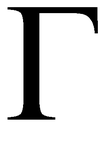
| Γ γ – English: gamma | ||
Etymology
From Phoenician 𐤂 (g, “camel”), supposedly because of its shape.
Pronunciation
- (5th BCE Attic) IPA(key): /ɡám.ma/
- (1st CE Egyptian) IPA(key): /ˈɡam.ma/
- (4th CE Koine) IPA(key): /ˈɣam.ma/
- (10th CE Byzantine) IPA(key): /ˈɣam.ma/
- (15th CE Constantinopolitan) IPA(key): /ˈɣa.ma/
Noun
γάμμα • (gámma) n (indeclinable)
References
- γάμμα in Liddell & Scott (1940) A Greek–English Lexicon, Oxford: Clarendon Press
- γάμμα in Liddell & Scott (1889) An Intermediate Greek–English Lexicon, New York: Harper & Brothers
- γάμμα in Bailly, Anatole (1935) Le Grand Bailly: Dictionnaire grec-français, Paris: Hachette
- γάμμα in the Diccionario Griego–Español en línea (2006–2018)
- γάμμα in Trapp, Erich, et al. (1994–2007) Lexikon zur byzantinischen Gräzität besonders des 9.-12. Jahrhunderts [the Lexicon of Byzantine Hellenism, Particularly the 9th–12th Centuries], Verlag der Österreichischen Akademie der Wissenschaften
Greek
Noun
γάμμα • (gámma) n (indeclinable)
- Alternative spelling of γάμα (gáma)
This article is issued from
Wiktionary.
The text is licensed under Creative Commons - Attribution - Sharealike.
Additional terms may apply for the media files.