6
It will be easily seen, that


Let us resume now the first equation

Suppose then or



The first and nth angles will then be equal.
We must observe, that there is a limit to the angle of incidence after it becomes negative, namely, the double right angle; if it becomes exactly equal to this, the last ray will be parallel to one of the mirrors; if greater, it would meet it if produced backwards.

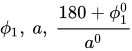
that is, if represent the number of degrees in must be a whole number.

CHAP.II.
REFLEXION AT SPHERICAL SURFACES.
8.Prop. Rays meeting in a point being incident on a spherical reflecting surface; it is required to determine the directions of the reflected rays.
Let Fig. 4, represent the spherical surface, which we will suppose concave, or rather a section of it by a diametric plane containing an incident ray being the point from which that and the other rays are supposed to proceed.

