| Range. | s. | s/C. | S(v). | v. | T(v). | t/C. | t. | T(v0). | v0. | D(v0) | φ/C. | φ. | β/C. | β. |
|---|---|---|---|---|---|---|---|---|---|---|---|---|---|---|
| 0 | 0 | 0 | 20700.53 | 2150 | 28.6891 | 0.0000 | 0.000 | 28.6891 | 2150 | 50.9219 | 0.0000 | 0.000 | 0.0000 | 0.000 |
| 500 | 1500 | 518 | 20182.53 | 1999 | 28.4399 | 0.2492 | 0.720 | 28.5645 | 2071 | 50.8132 | 0.1087 | 0.315 | 0.1135 | 0.328 |
| 1000 | 3000 | 1036 | 19664.53 | 1862 | 28.1711 | 0.5180 | 1.497 | 28.4301 | 1994 | 50.6913 | 0.2306 | 0.666 | 0.2486 | 0.718 |
| 1500 | 4500 | 1554 | 19146.53 | 1732 | 27.8815 | 0.8076 | 2.330 | 28.2853 | 1918 | 50.5542 | 0.3677 | 1.062 | 0.4085 | 1.181 |
| 2000 | 6000 | 2072 | 10628.53 | 1610 | 27.5728 | 1.1163 | 3.225 | 28.1310 | 1843 | 50.4029 | 0.5190 | 1.500 | 0.5989 | 1.734 |
|
|
|


| Remaining Velocity | To strike an object 10 ft. high range must be known to | Slope of Descent. | 5' elevation or depression alters point of impact. | Elevation. | Range. | Fuse scale for T. and P. middle No. 54 Marks I., II., or III. | 50% of rounds should fall in. | Time of Flight. | Penetration into Wrought Iron. | ||||
|---|---|---|---|---|---|---|---|---|---|---|---|---|---|
| Range. | Laterally or Vertically. | Length. | Breadth. | Height. | |||||||||
| f/s | yds. | 1 in. | yds. | yds. | ° | ' | yds. | yds. | yds. | yds. | secs. | in. | |
| 2154 | .. | .. | .. | 0.00 | 0 | 0 | 0 | .. | .. | .. | .. | 0.00 | 13.6 |
| 2122 | 1145 | 687 | 125 | 0.14 | 0 | 4 | 100 | 1/4 | .. | 0.4 | .. | 0.16 | 13.4 |
| 2091 | 635 | 381 | 125 | 0.29 | 0 | 9 | 200 | 3/4 | .. | 0.4 | .. | 0.31 | 13.2 |
| 2061 | 408 | 245 | 125 | 0.43 | 0 | 13 | 300 | 1 | .. | 0.4 | .. | 0.47 | 13.0 |
| 2032 | 316 | 190 | 125 | 0.58 | 0 | 17 | 400 | 1 1/4 | .. | 0.4 | .. | 0.62 | 12.8 |
| 2003 | 260 | 156 | 125 | 0.72 | 0 | 21 | 500 | 1 3/4 | .. | 0.5 | 0.2 | 0.78 | 12.6 |
| 1974 | 211 | 127 | 125 | 0.87 | 0 | 26 | 600 | 2 | .. | 0.5 | 0.2 | 0.95 | 12.4 |
| 1946 | 183 | 110 | 125 | 1.01 | 0 | 30 | 700 | 2 1/4 | .. | 0.5 | 0.2 | 1.11 | 12.2 |
| 1909 | 163 | 98 | 125 | 1.16 | 0 | 34 | 800 | 2 3/4 | .. | 0.5 | 0.2 | 1.28 | 12.0 |
| 1883 | 143 | 85 | 125 | 1.31 | 0 | 39 | 900 | 3 | .. | 0.6 | 0.3 | 1.44 | 11.8 |
| 1857 | 130 | 78 | 125 | 1.45 | 0 | 43 | 1000 | 3 1/4 | .. | 0.6 | 0.3 | 1.61 | 11.6 |
| 1830 | 118 | 71 | 125 | 1.60 | 0 | 47 | 1100 | 3 3/4 | .. | 0.6 | 0.3 | 1.78 | 11.4 |
| 1803 | 110 | 66 | 125 | 1.74 | 0 | 51 | 1200 | 4 | .. | 0.6 | 0.3 | 1.95 | 11.2 |
| 1776 | 101 | 61 | 125 | 1.89 | 0 | 55 | 1300 | 4 1/2 | .. | 0.7 | 0.4 | 2.12 | 11.0 |
| 1749 | 93 | 56 | 125 | 2.03 | 0 | 59 | 1400 | 4 3/4 | .. | 0.7 | 0.4 | 2.30 | 10.8 |
| 1722 | 86 | 52 | 125 | 2.18 | 1 | 3 | 1500 | 5 | .. | 0.7 | 0.4 | 2.47 | 10.6 |
| 1695 | 80 | 48 | 125 | 2.32 | 1 | 7 | 1600 | 5 1/2 | 25 | 0.8 | 0.5 | 2.65 | 10.5 |
| 1669 | 71 | 43 | 125 | 2.47 | 1 | 11 | 1700 | 5 3/4 | 25 | 0.9 | 0.5 | 2.84 | 10.3 |
| 1642 | 67 | 40 | 100 | 2.61 | 1 | 16 | 1800 | 6 1/4 | 25 | 1.0 | 0.5 | 3.03 | 10.1 |
| 1616 | 61 | 37 | 100 | 2.76 | 1 | 22 | 1900 | 6 1/2 | 25 | 1.1 | 0.6 | 3.23 | 9.9 |
| 1591 | 57 | 34 | 100 | 2.91 | 1 | 27 | 2000 | 7 | 25 | 1.2 | 0.6 | 3.41 | 9.7 |
| The last column in the Range Table giving the inches of penetration into wrought iron is calculated from the remaining velocity by an empirical formula, as explained in the article Armour Plates. | |||||||||||||
High Angle and Curved Fire.— "High angle fire," as defined officially, "is fire at elevations greater than 15°," and "curved fire is fire from howitzers at all angles of elevation not exceeding 15°". In these cases the curvature of the trajectory becomes considerable, and the formulae employed in direct fire must be modified; the method generally employed is due to Colonel Siacci of the Italian artillery.
Starting with the exact equations of motion in a resisting medium,
- (43)
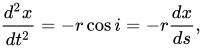
- (44)

and eliminating r,
- (45)
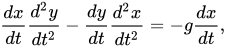
and this, in conjunction with
- (46)
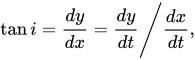
- (47)

reduces to
- (48)

the equation obtained, as in (18), by resolving normally in the trajectory, but di now denoting the increment of i in the increment of time dt.
Denoting dx/dt, the horizontal component of the velocity, by q, so that
- (49)

equation (43) becomes
- (50)

and therefore by (48)
- (51)
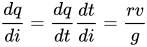
It is convenient to express r as a function of v in the previous notation
- (52)

and now
- (53)
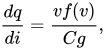
an equation connecting q and i.
Now, since v=q sec i
- (54)
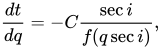
and multiplying by dx/dt or q,
- (55)
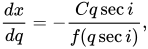
and multiplying by dx/dx or tan i,
- (56)
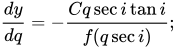
also
- (57)
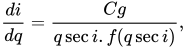
- (58)
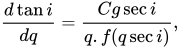
from which the values of t, x, y, i, and tan i are given by integration with respect to q, when sec i is given as a function of q by means of (51).
Now these integrations are quite intractable, even for a very simple mathematical assumption of the function f(v), say the quadratic or cubic law, f(v)=v2/k or v3/k.
But, as originally pointed out by Euler, the difficulty can be turned if we notice that in the ordinary trajectory of practice the quantities i, cos i, and sec i vary so slowly that they may be replaced by their mean values, η, cos η, and sec η, especially if the trajectory, when considerable, is divided up in the calculation into arcs of small curvature, the curvature of an arc being defined as the angle between the tangents or normals at the ends of the arc.
Replacing then the angle i on the right-hand side of equations (54)-(56) by some mean value η we introduce Siacci's pseudo-velocity u defined by
- (59)

so that u is a quasi-component parallel to the mean direction of the tangent, say the direction of the chord of the arc.