II. The Theory Of Symmetric Functions
Consider n quantities a1, a2, a3,...an.
Every rational integral function of these quantities, which does not alter its value however the n suffixes 1, 2, 3, ... n be permuted, is a rational integral symmetric function of the quantities. If we write (1 +a1x) (1 +a2x)...(1 +anx) = 1 +a1x + a2x² +... +anxn, a1, a2, ...an are called the elementary symmetric functions.
a1 = a1 + a2 +...+an = Σa1
a2 = a1a2 + a1a3 +...+a2a3 = Σa1a2
⋅⋅⋅⋅⋅
an = a1a2a3...an.
The general monomial symmetric function is
Σap1
1 ap2
2 ap3
3 ...apn
n,
the summation being for all permutations of the indices which result in different terms. The function is written
(p1p2p3...pn)
for brevity, and repetitions of numbers in the bracket are indicated by exponents, so that (p1p1p2) is written (p2
1p2). The weight of the function is the sum of the numbers in the bracket, and the degree the highest of those numbers.
Ex. gr. The elementary functions are denoted by
(l), (l2), (l3), ... (ln),
are all of the first degree, and are of weights 1, 2, 3,...n respectively.
Remark.—In this notation (0) = Σa0
1 = (n
1); (0²) = Σa0
1a0
2 = (n
1);... (0s) = (n
s), &c. The binomial coefficients appear, in fact, as symmetric functions, and this is frequently of importance.
The order of the numbers in the bracket (p1p2 ...pn) is immaterial; we may therefore always place them, as is most convenient, in descending order of magnitude; the numbers then constitute an ordered partition of the weight w, and the leading number denotes the degree.
The sum of the monomial functions of a given weight is called the homogeneous-product-sum or complete symmetric function of that weight; it is denoted by hw it is connected with the elementary functions by the formula
11 – a1x + a2x² a3x³ +... = 1 + h1x + h2x² + h3x³ + ...,
which remains true when the symbols a and h are interchanged, as is at once evident by writing –x for x. This proves, also, that in any formula connecting a1, a2, a3 ,... with h1, h2, h3,... the symbols a and h may be interchanged.
Ex. gr. from h2 = a2
1 – a2 we derive a2 = h2
1 – h2.
The function Σa p1
1a p2
2 ...a pn
n being as above denoted by a partition of the weight, viz. (p1p2 ...pn), it is necessary to bring under view other functions associated with the same series of numbers: such, for example, as
Σa p1
1a p3
2a p2
1a p4
2... a pn–2
n–2 = (p1p3)(p2p4 ...pn–2).
The expression just written is in fact a partition of a partition, and to avoid confusion of language will be termed a separation of a partition. A partition is separated into separates so as to produce a separation of the partition by writing down a set of partitions, each separate partition in its own brackets, so that when all the parts of these partitions are reassembled in a single bracket the partition which is separated is reproduced. It is convenient to write the distinct partitions or separates in descending order as regards weight. If the successive weights of the separates w1, w2, w3,... be enclosed in a bracket we obtain a partition of the weight w which appertains to the separated partition. This partition is termed the specification of the separation. The degree of the separation is the sum of the degrees of the component separates. A separation is the symbolic representation of a product of monomial symmetric functions. A partition, (p1p1p1p2p2p3) = (p3
1p2
2p3) can be separated in the manner (p1p2) (p1p2) (p1p3) = (p1p2)2 (p1p3), and we may take the general form of a partition to be (pw1
1 pw2
2 pw3
3 ...) and that of a separation (J1)f1 (J2)f2(J3)f3... when J1, J2, J3... denote the distinct separates involved.
Theorem.— The function symbolized by (n), viz. the sum of the nth powers of the quantities, is expressible in terms of functions which are symbolized by separations of any partition (nv1
1 nv2
2 nv3
3 ...) of the number n. The expression is—
(–) v1+v2v3+...(v1+v2v3+...)– 1)!v1!+v2!v3!+... (n)
=Σ (–) j1+j2j3+... (j1+j2j3+...)– 1)!j1!+j2!j3!+...(J1)j1 (J2)j2(J3)j3...,
(J1)j1 (J2)j2(J3)j3... being a separation of (nv1
1 nv2
2 nv3
3 ...) and the summation being in regard to all such separations. For the particular case (nv1
1 nv2
2 nv3
3 ...) = (ln)
(−)nln(n) = Σ (–) j1+j2j3+... (j1+j2j3+...)– 1)!j1!+j2!j3!+...(l)j1 (l²)j2(l³)j3...
To establish this write—
1 + μX1 + μ²X2 + μ³X3 +... = II
a(l + μa1x1 + μ²a2
1x2 + μ³a3
1x3 + ...),
the product on the right involving a factor for each of the quantities a1, a2, a3..., and μ being arbitrary.
Multiplying out the right-hand side and comparing coefficients
X1 = (l)x1,
X2 = (2)x2 + (l²)x2
1,
X3 = (3)x3 + (2l)x2x1 + (l³)x3
1,
X4 = (4)x4 + (3l)x3x1 + (2²)x2
2+ (2l²)x2x2
1 (l4)x3
1,
•••••••
Xm=Σ(mμ1
1mμ2
2mμ3
3 ...)xμ1
m1...,
the summation being for all partitions of m.
Auxiliary Theorem.—The coefficient of xλ1
l1xλ2
l2xλ3
l3... in the product
X μ1
m1X μ2
m1X μ3
m1...μ1!μ2!μ3!... is Σ (J1) j1(J2)j2(J3)j3... where J1) j1(J2)j2(J3)j3...is a separation of (lλ1
1lλ2
2lλ3
3 ...) of specification (mμ1
1mμ2
2mμ3
3 ...), and the sum is for all such separations.
To establish this observe the result.
1p!Xp3 =Σ (3)π1 (2l)π2 (13)π3π1!π2!π3!xπ13xπ22 xπ2+3π31
and remark that (3)π1(2I)π2(I3)π3 is a separation of (3π12π21π2+3π3) of specification (3p). A similar remark may be made in respect of
1μ1!Xμ1
m1, 1μ2!Xμ2
m2, 1μ3!Xμ3
m3, ...
and therefore of the product of those expressions. Hence the theorem.
Now
log (1+μX1 +μ2X2+μ3X3 +...)
=Σ log (1+μα1+μ2α2
1+μ3α3
1+...) whence, expanding by the exponential and multinomial theorems, a comparison of the coefficients of μn gives
(n)Σ (−)ν1+ν2+ν3+...−1 (ν1+ν2+ν3+...−1)!ν!1+ν2!+ν3!+...
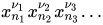
= Σ ν1+ν2+ν3+...1 (111+112+Y3+... - 1) !Xv1Xv2Xv3 Y1!Y2!1,3!... n1 n 2 n 3 �� � and, by the auxiliary theorem, any term on the right-hand side is such that the coefficient of in
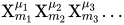
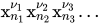
(J1)11(J2)12(J3)j3�.� jj!j2!j3!..� where since(m1 1 m2 2 m3 3 ...) is the specification of (J1)j1(J2)j2(J3)j3..., � l +�2+/23+��� =ii +j2+j3+���� Comparison of the coefficients of x:14243... therefore yields the result (-) V1+v2+v3+... (P i +Y2+t' +...-1)! () n VI!Y2!P3!...
) j1+j2+j3+..� (J1+ j2 +j3+...-1)!/T1)?1(J2)72 (J 3)/3..., j11j2!j3!... ?.1 for the expression of Za n in terms of products of symmetric functions symbolized by separations of ( n 1 1n 2 2n 3 3) Let (n) a, (n) x, (n) X denote the sums of the n th powers of quantities whose elementary symmetric functions are a1, a2, a3,...; x1, x2, x3,..; X1, X2, X3.... respectively: then the result arrived at above from the logarithmic expansion may be written (n)a(n)x = (n)x,
exhibiting (n) $ as an invariant of the transformation given by the expressions of X1, X2, X3... in terms of x1, x2, x3,....
The inverse question is the expression of any monomial symmetric function by means of the power functions (r) = sr.
Theorem of Reciprocity.—If
X1 P2 "3 01 Q 2 7 3 Al A 2 A3 X m1 X m2 X m3 ... = ...+O(s i s 2 s 3 ...)xl1x12x13...+..., where 0 is a numerical coefficient, then also O ?2 0.3 P1 P2 P3 Al A2 A3 +.
X,1X82>$3...=...+8(m m m ...)x 11 x 12 x13......
1 2 3
We have found above that the coefficient of (x 1 1 x 12 x 13...) i n the product XmiXm2X m3 ... is �1!�2!�3!
'1 +� �.(11+j2+j3+... -1)!
(1)/1(12) 2(13)73....
(J1)ji(J2)72(J3)13��� jl!j2!j3!...
the sum being for all separations of l1l2l3 ...) which have the specification (m41 m2 2 m3 3 ...). We can multiply out this expression so as to obtain a series of monomials of the form 9(sl is2 2 s3 3 ...). It can be shown that the number 0 enumerates distributions of a certain nature defined by the partitions (m1,m2...), (sT1s°2...), 1212 an = a 1 a 2 a 3 ... an.