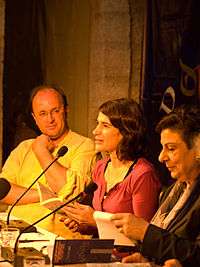
William Dalrymple (left) with Esther Freud (centre) and Hanan Ashrawi at PalFest 2008.
William Dalrymple (historian) (born March 20, 1965) is a British historian, and writer, art historian and curator, as well as a prominent broadcaster and critic. His interests include the history and art of India, Pakistan, Afghanistan, the Middle East, the Muslim world, Hinduism, Buddhism, the Jains and early Eastern Christianity.
Quotes
- In the course of my travels I often came across the assumption that intense spirituality was somehow the preserve of what many call 'the mystic east'... it's a misconception that has always irritated me as I've always regarded our own indigenous British traditions of spirituality as especially rich.
- I am basically writing for a general audience rather than an academic audience. So, I explain stuff, I don’t assume knowledge of any of this on the part of the reader. In a kind of general sense I suppose I have, when I am deciding how much needs to be explained, in mind my primary audience.
- In Amrita Ghosh, Author in Focus: An Interview with Dalrymple, Cerebration.Org.
- I am a terrible linguist. It`s a great shame that I have not learnt Urdu and Persian.
- In Zeenews, William Dalrymple's book on first Anglo-Afghan war out in December, IANS, 12 September 2012,
- I am writing definitely primarily for an audience who don’t know India.
- In Amrita Ghosh, "Author in Focus: An Interview with Dalrymple".
- Actually, when you have been in the country for a long time... whether it’s an Indian kid going to live in California working in a software company or whether its me coming to live here as historian and writer; to a certain extent you become a part of the country, and to a certain extent you remain always the person you were with the set of circumstances, history or personal history. So, I don’t think I can ever totally become Indian, but after twenty years I have certainly taken many of the Indian elements. In fact I am sitting talking to you right now in my cotton pajamas and at lunch time I will probably have dal and rice. In various ways I have taken on the life of Delhi; I think I am in the lucky position, in that I can talk to both worlds.
- In Amrita Ghosh, "Author in Focus: An Interview with Dalrymple".
- Everybody has their own India and I think it’s a nonsense construction, “a real India”. The real India might be the India of the villages and certainly there’s a lot to be said of the fact that India’s heart lies in its villages. But I live 5 miles down the road from Gurgaon with kyscrapers and software companies and backoffice projects and call-centers. And that’s a very real India too, so I think “real India” doesn’t make much sense-- anymore than the real US with apple pie and Thanksgiving and family around campfires; is that anymore real than Manhattan?
- In Amrita Ghosh, "Author in Focus: An Interview with Dalrymple".
- What has gone on in Iraq and Afghanistan has many echoes with what was going in this part of the world in 18th and 19th century - setting up of puppet governments, the lending of troops and the training of local troops in recent Western techniques. Anyone that knows the history of South Asia in 18th century can see million echoes in what has been going in Iraq and Afghanistan.
- In Zeenews, "William Dalrymple's book on first Anglo-Afghan war out in December"
- The current Western puppet Hamid Karzai is from the same sub-tribe as Shah Shuja, who was a British puppet in 1839, It is the same war under slightly different flags.
- In Zeenews, "William Dalrymple's book on first Anglo-Afghan war out in December"
- Pointed out that the Afghan tribe which resisted 1839 invasion now make up of the foot soldiers of Taliban.
About William Dalrymple
- Dalrymple is [also] British—Scottish, to be exact—but his controversial statements are more likely to concern the country's [India’s] Mughal or British past. He is today India's most famous narrative historian.
- Karan Mahajan, in The Don of Delhi, Bookforum February/March 2011.
- His fluent and moving presentations of big subjects—India's first war of independence in "The Last Mughal (2006)", for example — sometimes irritate native historians who feel they have been scooped by a powerful foreign interest, but this is a little unfair:..Dalrymple's success has shown that there is a market for well-written history in India. This is itself an achievement.
- Karan Mahajan, in "The Don of Delhi".
- In the past twenty years, he has rigorously pursued fascination for [India], writing one brilliant travel book (City of Djinns: A Year in Delhi), two vivid histories (White Mughals and The Last Mughal), and one anthology of acute acute journalism (The Age of Kali) about South Asia. He came to India before it had achieved its status as a frontier boomland for computer programmers and writers alike, and he has lived there, on and off, since 1989... he has become something of a godfather to a generation of writers who are producing nonfiction about the country. The fact that Dalrymple looks like a sunnier version of the actor James Gandolfini and loves to party no doubt helps with this reputation.
- Karan Mahajan, in "The Don of Delhi".
- He is one of Britain’s most successful travel writers, whose highly entertaining books elegantly combine scholarship and story-telling, trans-cultural investigations and romance.
- Jules Smith, in William Dalrymple: Critical Perspective, 2007, British Council.
- Interpretation of previously untranslated documents in the Indian national archives offers a wealth of new perspectives on the Uprising and its aftermath. Inevitably, such an account of the conflict between Evangelical Christianity and Muslims brings to mind contemporary conflicts, and helps us to understand them.
- Jules Smith, in "William Dalrymple: Critical Perspective".
- In his view, Western Imperialism and Islamic fundamentalism have long been ‘dangerously intertwined’.
- Jules Smith, in "William Dalrymple: Critical Perspective".
- And who was this speaker, anyway? I waited to the end, enduring the nonsense of it all just to find out. It turned out to be William Dalrymple. Ah, of course. William Dalrymple, described here long ago, quite accurately, as an up-market Barbara Cartland, whose tales of trans-racial passion at the Mughal Court, or at this or that princely court in the time of the Mughals, has it all: star-crossed lovers, and of course the Splendor That Was India, or rather the India of the Muslim rulers who lived off of their Hindu subjects, the subjects who were killed by the Muslims in numbers without any historical parallel. (The historian K. S. Lal and others estimate that 60-70 million Hindus were killed by the Muslim conquerors and masters). Now a love of luxe, and of luxe combined with heaving breasts, is the kind of thing that the Barbara-Cartlands of this world love, including even the plausible sort who put in a bit more history and a little less of the Romance-novelette lord or duke or Arab prince (see “The Sheik”), who picks up the girl in her swoon at the very end (the promise of sex has always been just beyond what Nabokov calls “the skyline of the page”) — that is, William Dalrymple. He’s as vulgar and stupid as they come, behind the plummy voice and the pretense of being a historian.
- The motives of people like Dalrymple, those who wilfully set out to deny the facts of the destruction of the Hindu civilisation of India, are the opposite. Their denial of the large-scale destruction and denigration of Hindu religion and culture by the Muslim raiders, invaders and conquerors of India is motivated by the deep-seated political aim of the Independence movement to brook no divide between Hindu and Muslim.It was for its time and for all time a noble aim. That was one of the things V.S. Naipaul said to the BJP gathering--that the project of Nehru and Gandhi to avoid going into the import of that history was in itself positively motivated. There is never any justification for one community in India to conduct a pogrom against another. Not then, not now. But surely the construction of history should be truthful. Suppression can only exacerbate the anger.
- Farrukh Dhondy, Does Willy Get It Wilfully Wrong?, Outlook India,
External links
This article is issued from
Wikiquote.
The text is licensed under Creative
Commons - Attribution - Sharealike.
Additional terms may apply for the media files.