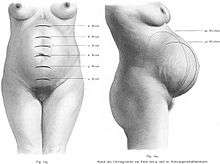
Pregnancy, also known as gestation, is the time during which one or more offspring develops inside a woman.
Quotes
Pregnancy seemed like a tremendous abdication of control. Something growing inside you which would eventually usurp your life. ~ Erica Jong
- Eric Johnston, an attorney who helped draft the Alabama bill, thinks a man and a woman can have sex and go straight to a clinic to determine if she’s pregnant. First off, you’ve gotta give her six minutes to clench her way to a toilet; otherwise she’s gonna get a UTI and ruin an exam table. Secondly, that isn’t how it works. . . It's still hard to know if you're pregnant at six weeks. You might have no symptoms, or if you do, they’re symptoms like fatigue or bloating and gas. On the other hand, it does explain P.F. Chang’s new motto: ‘Maybe it’s not us; maybe you’re pregnant!’
- Samantha Bee, Full Frontal with Samantha Bee, (5/15/2019); as qtd. in Laura Bradley, "Samantha Bee Teaches “F--king Idiots” Behind Abortion Laws Some Sex Ed", Vanity Fair, (May 16, 2019).
- The bearing of a child takes nine months, no matter how many women are assigned.
- Fred Brooks, The Mythical Man-Month: Essays on Software Engineering (1975, 1995) Page 17, cf. Theodore von Kármán (1957): "Everyone knows it takes a woman nine months to have a baby. But you Americans think if you get nine women pregnant, you can have a baby in a month."
- Techniques that entail the dissociation of husband and wife, by the intrusion of a person other than the couple (donation of sperm or ovum, surrogate uterus), are gravely immoral.
- "Paragraph 2376". Catechism of the Catholic Church.
- Techniques involving only the married couple (homologous artificial insemination and fertilization) are perhaps less reprehensible, yet remain morally unacceptable. They dissociate the sexual act from the procreative act. The act which brings the child into existence is no longer an act by which two persons give themselves to one another, but one that "entrusts the life and identity of the embryo into the power of doctors and biologists and establishes the domination of technology over the origin and destiny of the human person. Such a relationship of domination is in itself contrary to the dignity and equality that must be common to parents and children."
- "Catechism of the Catholic Church. Section 2377". Rome: Vatican. 1993. Retrieved 25 November 2008.
- Pregnancy seemed like a tremendous abdication of control. Something growing inside you which would eventually usurp your life.
- Erica Jong, Fear of Flying, (1973).
- A Padmini procreates once in four years, Chitarini once in three, Hastini once in two and Sankhini every year.
- Labdhodaya in his Padmini Charitra Choupai. quoted from B.K. Karkra, Rani Padmini, The Heroine of Chittor. (2009) Rupa.
- A significant number of the respondents were under misapprehensions as to what caused the loss of the pregnancy. Three-quarters believed that a stressful event could bring about a miscarriage, 64% thought that lifting a heavy object could be a cause, and a fifth that previous use of oral contraceptives could induce pregnancy loss.
- Of those who took part 15% said they or their partner had suffered a miscarriage, but the majority of respondents (55%) believed that miscarriages are uncommon (defined as less than 6% of all pregnancies). The truth is that miscarriages end one in four pregnancies and are by far the most common pregnancy complication, the paper says.
A fifth of people incorrectly believed that lifestyle choices during pregnancy, such as smoking or using drugs or alcohol, were the single most common cause of miscarriage, more common than genetic or medical causes. In reality, 60% of miscarriages are caused by a genetic problem. - The authors concluded: “Patients who have experienced miscarriage may benefit from further counselling by healthcare providers, identification of the cause, and revelations from friends and celebrities. Healthcare providers have an important role in assessing and educating all pregnant patients about known prenatal risk factors, diminishing concerns about unsubstantiated but prevalent myths and, among those who experience a miscarriage, acknowledging and dissuading feelings of guilt and shame.”
- Haroon Sadique, "Miscarriage misconceptions boost feelings of guilt and shame, study says", The Guardian, (11 May 2015).
- Q: Some women say being pregnant made them feel powerful and some say they felt vulnerable. I’m guessing you mainly felt powerful.
- Ali Wong: I felt powerful in this way of “I don’t give a fuck about what people think,” and I felt this life running through me when she was kicking me. But I did also feel really vulnerable. You become like a vampire when you’re pregnant: your senses are so sensitive and your emotions are so heightened – that helps with performance because you really feel things. Any stories about something happening to little girls killed me. Put it this way: I did not find Inside Out uplifting.
- Q: You’re the first comedian to make a special while pregnant. Was it important to you to break that barrier?
- Ali Wong: Being the first to do it was less important to me than just getting it done before I had the baby. When I planned it in my first trimester I had no idea how I’d look or feel in my third. I had no idea about things like the severe constipations, the bleeding gums or that my lasered moustache would come back. So those were all fun surprises.
- Q: The moment in your special that really made me gasp out loud is when you joke about how you suffered a miscarriage before, and how you were secretly relieved because they were twins. Do you think that joke only works because the audience could see that you got pregnant again so there is redemption to the loss?
- Ali Wong: I think that’s part of it, for sure. But it really helped me when I had a miscarriage to talk to other women and hear that they’d been through it, too. It’s one thing to hear the statistics but it’s another to put faces to the numbers so you stop feeling like it’s your fault. I think that’s one of the reasons women don’t tell people when they’ve had a miscarriage – they think it’s their fault. I remember I worried what my in-laws would think, which is so crazy. I thought they’d think their son had married a terrible person. Also, because I made the mistake of telling people as soon as I got pregnant, I then had to tell them the bad news and then I felt like I was burdening them. So being able to joke about it was such a relief.
Comedy only works when it comes from an honest place and the relief that I’d miscarried twins was real!
- Ali Wong in "Ali Wong: 'Being able to joke about my miscarriage was a relief'", by Hadley Freeman, The Guardian, (9 Jun, 2016).
See also
External links
This article is issued from
Wikiquote.
The text is licensed under Creative
Commons - Attribution - Sharealike.
Additional terms may apply for the media files.