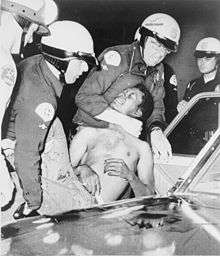
Political repression in the United States has reached monstrous proportions. Black and Brown peoples especially, victims of the most vicious and calculated forms of class, national and racial oppression, bear the brunt of this repression. Literally tens of thousands of innocent men and women, the overwhelming majority of them poor, fill the jails and prisons. ... Repression is the response of an increasingly desperate imperialist ruling clique to contain an otherwise uncontrollable and growing popular disaffection leading ultimately, we think, to the revolutionary transformation of society. ~ Angela Davis
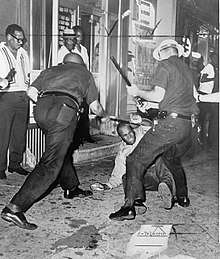
The police in our community occupy our area, our community, as a foreign troop occupies territory, and the police are there in our community not to promote our welfare, or for our security and our safety, but they’re there to contain us, to brutalize us and murder us. ... The police in our community couldn’t possibly be there to protect our property because we own no property. ~ Huey P. Newton
* The inflexibility of the laws, which prevents them from adapting themselves to circumstances, may, in certain cases, render them disastrous, and make them bring about, at a time of crisis, the ruin of the State. ~ Jean-Jacques Rousseau
Every law the people has not ratified in person is null and void - is, in fact, not a law. ~ Jean-Jacques Rousseau
Collecting data in and of itself is a good mechanism to hold police agencies accountable ~ Andrew Wheeler
Police are a constituted body of persons empowered by a state to enforce the law.
Quotes
- Bad cops are the product of bad policy. And policy is ultimately made by politicians. A bad system loaded with bad incentives will unfailingly produce bad cops. The good ones will never enter the field in the first place, or they will become frustrated and leave police work, or they'll simply turn bad. At best, they'll have unrewarding, unfulfilling jobs.
- Radley Balko, Rise of the Warrior Cop: the Militarization of America's Police Forces
- One statistic that has been widely discussed after Michael Brown's death is the one stating that a black person is killed by a police officer, security guard, or vigilante, every 28 hours. While some may wonder why vigilante was added to that statistic, it was because of the infamous shooting death of Trayvon Martin in 2012 by George Zimmerman, who was a neighborhood watch volunteer. Although it took months of protesting to get George charged, a jury eventually acquitted him of all charges which led to the birth of the Black Lives Matter movement — the same movement that rallied the protests in Ferguson after Michael Brown died.
- Lincoln Anthony Blades, "How Michael Brown's Death Awakened A Nation to Police Brutality”, Teen Vogue, (August 9, 2018).
- Political repression in the United States has reached monstrous proportions. Black and Brown peoples especially, victims of the most vicious and calculated forms of class, national and racial oppression, bear the brunt of this repression. Literally tens of thousands of innocent men and women, the overwhelming majority of them poor, fill the jails and prisons; hundreds of thousands more, including the most presumably respectable groups and individuals, are subject to police, FBI and military intelligence surveillance. The Nixon administration most recently responded to the massive protests against the war in Indochina by arresting more than 13,000 people and placing them in stadiums converted into detention centers. ... Repression is the response of an increasingly desperate imperialist ruling clique to contain an otherwise uncontrollable and growing popular disaffection leading ultimately, we think, to the revolutionary transformation of society.
- Angela Davis, If They Come in The Morning (1971)
- Now, as a cadet, your training barely covered the importance of how to interact with America's one million Deaf citizens.
- American Sign Language is naturally big and expressive. But some officers mistake it as wild or aggressive.
- Presentations of police are often over-dramatized and romanticized by fictional television crime dramas while the news media portray the police as heroic, professional crime fighters (Surette, 1998; Reiner, 1985). In television crime dramas, the majority of crimes are solved and criminal suspects are successfully apprehended (Dominick, 1973; Estep and MacDonald, 1984; Carlson, 1985; Kooistra et al. 1998, Zillman and Wakshlag, 1985). Similarly, news accounts tend to exaggerate the proportion of offenses that result in arrest which projects an image that police are more effective than official statistics demonstrate (Sacco and Fair, 1988; Skogan and Maxfield, 1981; Marsh, 1991; Roshier, 1973). The favorable view of policing is partly a consequence of police’s public relations strategy. Reporting of proactive police activity creates an image of the police as effective and efficient investigators of crime (Christensen, Schmidt and Henderson, 1982). Accordingly, a positive police portrayal reinforces traditional approaches to law and order that involves increased police presence, harsher penalties and increasing police power (Sacco, 1995).
- Kenneth Dowler, “Media Consumption and Public Attitudes Toward Crime and Justice: The Relationship Between Fear of Crime, Punitive Attitudes, and Perceived Police Effectiveness", Journal of Criminal Justice and Popular Culture, 10(2) (2003), p.111.
- The public has a long-standing fascination with crime, law, and justice. Crime is a central feature in news, newsmagazines, documentaries, reality-based shows, and fictional drama. The experiences of police, lawyers, judges, private investigators, medical examiners, correctional workers, criminals, and victims are probed in a variety of television shows. Every year, television executives attempt to find crime and justice programs that capture viewers and enjoy high ratings (Bielby & Bielby, 1994). In particular, the police drama or procedural is a staple of television programming in the United States, and several shows have experienced critical acclaim, large viewing audiences, and longevity. Since 1950, there have been almost 300 police dramas that have appeared on network, cable, and syndicated television (Brooks & Marsh, 2007). This number does not include the large number of shows that focus on other elements of crime and justice, such as detective shows, shows based on lawyers, judges, correctional workers, and criminals.
- Ken Dowler, “Police Dramas on Television”, Crime, Media, and Popular Culture, (Nov 2016).
- What is the Police? This we can best answer by a deduction of the conception of the police power of the state. The state, as such, has entered into a common compact with its citizens by which each party assumes certain duties and receives certain rights. We have shown the means of connection between the state and the citizens in all cases in which the citizen can and undoubtedly will prefer complaint. He who violates a police law must suffer all the disagreeable consequences which may result to him, and is, moreover, liable to a fine. The chief principle of a well-regulated police is this: That each citizen shall be at all times and places, when it may be necessary, recognised as this or that particular person. No one must remain unknown to the police.
- The Science of Rights 1796 by, Johann Gottlieb Fichte, 1762-1814; Kroeger, Adolph Ernest, 1837-1882, tr Publication date 1889 P. 374, 378
- Why should a government secretly place a watch over its citizens? In order that they may not believe themselves watched. But why should they not believe themselves watched? That they may discover their thoughts respecting the government and its plans, and may thus become their own betrayers; or may betray whatever they know of other secret and illegal acts. The former is necessary only where government and citizens live in perpetual war with each other; where the citizens are unjustly oppressed, and seek to regain their freedom again by employing all the means and tricks of war: the latter is necessary only where the police are not watchful enough. ** The Science of Rights 1796 by, Johann Gottlieb Fichte, 1762-1814; Kroeger, Adolph Ernest, 1837-1882, tr Publication date 1889 P. 391
- I'm convinced that it is the psychopathic personality that searches out a uniform. There's little doubt of what's going on in that man's head who will voluntarily don any uniform
- George Jackson, Soledad Brother: The Prison Letters of George Jackson, p. 160
- If you ever saw a policeman with a club in his hand, I want to ask you, did you ever see that policeman club a millionaire? But it is "Get out of here, damn you, go on to jail, damn you," if it is a working man.
- Mother Jones, Speech in Princeton, WV. (15 August 1920)
- Men were not created in order to obey laws. Laws are created to obey men. They are established by men and should serve men. The laws and rules which officials inflict upon poor people prevent them from functioning harmoniously in society. There is no disagreements about this function of law in any circle-the disagreement arises from the question of which men laws are to serve. Such lawmakers ignore the fact that it is the duty of the poor and unrepresented to construct rules and laws that serve their interest better. Rewriting unjust laws is a basic human right and fundamental obligation.
- Huey P. Newton, "In Defense of Self-defense" I (June 20, 1967)
- In America, black people are treated very much as the Vietnamese people or any other colonized people because we’re used, we’re brutalized. The police in our community occupy our area, our community, as a foreign troop occupies territory, and the police are there in our community not to promote our welfare, or for our security and our safety, but they’re there to contain us, to brutalize us and murder us, because they have their orders to do so, just as the soldiers in Vietnam have their orders to destroy the Vietnamese people. The police in our community couldn’t possibly be there to protect our property because we own no property. They couldn’t possibly be there to see that we receive the due process of law for the simple reason that the police themselves deny us the due process of law. And so it’s very apparent that the police are only in our community, not for our security, but the security of the business owners in the community and also to see that the status quo is kept intact.
- Huey P. Newton, Interview, c. 1966
- Fuck the police comin' straight from the underground
A young nigga got it bad 'cause I'm brown
And not the other color so police think
They have the authority to kill a minority.- NWA, "Fuck tha Police"
- In the United States, police officers fatally shoot about three people per day on average, a number that’s close to the yearly totals for other wealthy nations. But data on these deadly encounters have been hard to come by.
- Lynne Peeples, “What the data say about police shootings”, Nature, 573, (04 September 2019), pp. 24-26.
- Although the databases are still imperfect, they make it clear that police officers’ use of lethal force is much more common than previously thought, and that it varies significantly across the country, including the two locations where Brown and Garner lost their lives. St Louis (of which Ferguson is a suburb) has one of the highest rates of police shooting civilians per capita in the United States, whereas New York City consistently has one of the lowest, according to one database. Deciphering what practices and policies drive such differences could identify opportunities to reduce the number of shootings and deaths for both civilians and police officers, scientists say.
- Lynne Peeples, “What the data say about police shootings”, Nature, 573, (04 September 2019), pp. 24-26.
- Andrew Wheeler, a criminologist at the University of Texas at Dallas, says that national-level databases should at least include all levels of use of force — down to the drawing of a weapon — in order to answer questions and create change. “Collecting data in and of itself is a good mechanism to hold police agencies accountable,” he says.
- Lynne Peeples, “What the data say about police shootings”, Nature, 573, (04 September 2019), pp. 24-26.
- The inflexibility of the laws, which prevents them from adapting themselves to circumstances, may, in certain cases, render them disastrous, and make them bring about, at a time of crisis, the ruin of the State.
- Due to the lack of federal record-keeping, we can’t even tell you precisely how many people are killed by police in the US in any given year, let alone how many of them are disabled. But we do know it’s a lot: A report from the Ruderman Family Foundation earlier this year found wildly varying estimates of the number of disabled people killed by police, from 25 percent to more than 40 percent of police shooting victims. For perspective, census data puts the overall incidence of disability at about 20 percent of the population.
- S.E., Smith, “Disability is a hidden side of the police violence epidemic“, Vox, (Oct 4, 2016).
See also
External links
This article is issued from
Wikiquote.
The text is licensed under Creative
Commons - Attribution - Sharealike.
Additional terms may apply for the media files.