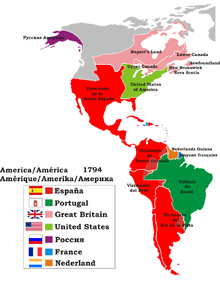
The European colonization of the Americas is the history of the settlement and establishment of control of the continents of the Americas by most of the naval powers of Western Europe.
Quotes

Any white person who brings the element of civilization has the right to take over this continent. ~ Ayn Rand
From the earliest arrival of Europeans on America’s shores, religion has often been a cudgel, used to discriminate, suppress and even kill the foreign, the “heretic” and the “unbeliever”—including the “heathen” natives already here. ~ Kenneth C. Davis
- When they laid down their arms, we murdered them. We lied to them. We cheated them out of their lands. We starved them into signing fraudulent agreements that we called treaties which we never kept. We turned them into beggars on a continent that gave life for as long as life can remember. And by any interpretation of history, however twisted, we did not do right. We were not lawful nor were we just in what we did. For them, we do not have to restore these people, we do not have to live up to some agreements, because it is given to us by virtue of our power to attack the rights of others, to take their property, to take their lives when they are trying to defend their land and liberty, and to make their virtues a crime and our own vices virtues.
- Marlon Brando, "Speech for the Academy Awards protesting the treatment of American Indians", written by Brando, as it appeared in the New York Times (March 30, 1973)
- From the earliest arrival of Europeans on America’s shores, religion has often been a cudgel, used to discriminate, suppress and even kill the foreign, the “heretic” and the “unbeliever”—including the “heathen” natives already here. Moreover, while it is true that the vast majority of early-generation Americans were Christian, the pitched battles between various Protestant sects and, more explosively, between Protestants and Catholics, present an unavoidable contradiction to the widely held notion that America is a “Christian nation.”
First, a little overlooked history: the initial encounter between Europeans in the future United States came with the establishment of a Huguenot (French Protestant) colony in 1564 at Fort Caroline (near modern Jacksonville, Florida). More than half a century before the Mayflower set sail, French pilgrims had come to America in search of religious freedom.
The Spanish had other ideas. In 1565, they established a forward operating base at St. Augustine and proceeded to wipe out the Fort Caroline colony. The Spanish commander, Pedro Menéndez de Avilés, wrote to the Spanish King Philip II that he had “hanged all those we had found in [Fort Caroline] because...they were scattering the odious Lutheran doctrine in these Provinces.” When hundreds of survivors of a shipwrecked French fleet washed up on the beaches of Florida, they were put to the sword, beside a river the Spanish called Matanzas (“slaughters”). In other words, the first encounter between European Christians in America ended in a blood bath.- Kenneth C. Davis, “America’s True History of Religious Tolerance“, Smithsonian Magazine, (October 2010).
- In 1863, Colonel Kit Carson was ordered to clear the country of Navajo Indians and to resettle any survivors at Fort Sumner in eastern New Mexico, where they could be "civilized." Carson's strategy was the same as that applied against the Plains Indians a little later: He destroyed the Navajo food base by systematically killing their livestock and by burning their fields. Carson's "Long Knives" (his soldiers so named because of their bayonets) also cut off the breast of Navajo girls and tossed them back and forth like baseballs.
- Peter Farb, Man's Rise to Civilization, (1968)
- The appearance of pirates on the coasts of America was coeval with the earliest settlements in the new world, and to secure a complete view of their history, we have to refer to conditions which existed far back in the middle of the sixteenth century. But these piracies are not to be considered as a apart of those which enter so largely into the commercial history of the North American colonies, or those of the South o which we propose to speak more particularly. At that time the English colonies had not yet been planted, and it was from the founding of these that the occurrences of the seventeenth and eighteenth centuries, which had to great an effect on commerce, date. Many of the earliest settlers were adventurers, not in the then honorable meaning of that term, but in the strictest latter-day disreputable sense. The countries of Europe when anxious to rid themselves of turbulent elements, offered special inducements to the objectionable individuals to emigrate. By England in particular was this custom practiced, and the better classes in the colonies frequently complained of the unloading of the refuse population of the mother-country on their shores. Under these circumstances it is not surprising that bold, bad men with criminal propensities, if not genuine outlaws, flocked to America as a field in which they could indulge their evil adventures with comparatively little interruption, and it was this class that fostered the spirit which soon broke forth in all kinds of crime and lawlessness.
- S. C. Hughson, “Early Piracy and Colonial Commerce”, The Sewanee Review, Vol. 1, No. 1 (Nov., 1892), pp. 53-54.
- They (Native Americans) didn't have any rights to the land, and there was no reason for anyone to grant them rights which they had not conceived and were not using. What was it that they were fighting for, when they opposed white person on this continent? For their wish to continue a primitive existence, their 'right' to keep part of the earth untouched, unused and not even as property, but just keep everybody out so that you will live practically like an animal, or a few caves above it. Any white person who brings the element of civilization has the right to take over this continent.
- Ayn Rand, Q and A session following her address to the graduating class of The United States Military Academy at West Point, New York, March 6, 1974 - found in Endgame: Resistance, by Derrick Jensen, Seven Stories Press, 2006, pg 220
See also
External links
This article is issued from
Wikiquote.
The text is licensed under Creative
Commons - Attribution - Sharealike.
Additional terms may apply for the media files.