It depends a lot on the hardware, and on the architecture. OpenSSL use some assembly-optimized routines, which result in a speed factor of +- x2 between 32 bit and 64 bit (the latter is faster). That said, I've seen verifications taking around 0.47 ms on an Intel Xeon E5-1650 @ 3.20GHz, using 64-bit code.
Also, version 0.8 will actually do signature verification in parallel. There is also a patch with an optimized ECDSA verifier for the specific curve we're using, which should give a 20% speedup (discovered by Hal Finney). This patch will probably not make it into v0.8, though.


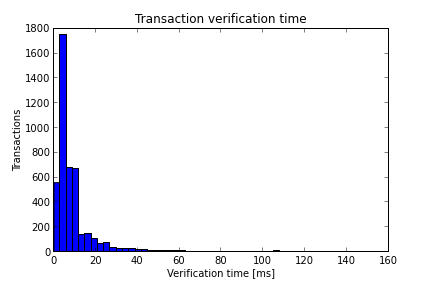

Just testing the digital signature verification using the OpenSSL code on a single core of a Core 2 Q9550, I get 725 microseconds per verification, a shade under 1 millisecond. This may be a bit unrealistic because all the ECDSA code is hot in the cache and the branch prediction is primed. (Test was doing verifications in a tight loop.) – David Schwartz – 2013-01-31T21:21:09.420
2The 0.8 code (unreleased currently) has a -benchmark function which measures block connection and signature verifications. You are certainly not just measuring signature validation. – Pieter Wuille – 2013-01-31T22:23:25.787
Yep, I needed the benchmark for something else, where the whole processing time of transactions was more relevant. – cdecker – 2013-02-01T08:56:25.583