If you have A, HB and HAB you can obviously check whether A fits. As Jestin noted this is essentially a full Merkle tree with two leaves.
However, as a thin client, you only have readily available the Merkle root (which is in the block header) and get told about A. The intermediate levels of the Merkle tree are not provided, therefore, to calculate them, you'd need the block's complete set of transactions.
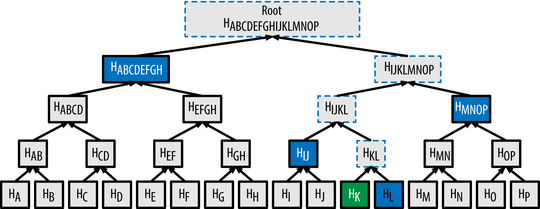 Image via Mastering Bitcoin
So, for a thin client, we calculate the Merkle branch instead. For the Merkle branch, we just need the transaction's position in the block's transaction list and the hashing partners at each level, instead of the complete set of transactions. A Merkle branch is impractical to fake because it would require finding of a hash collision (which is not doable, or mining wouldn't work). So by going up the tree and combining our result with the respective hashing partner at each level, we finally get the Merkle root. Thus we can prove membership of the transaction in the block.
In the example image, you only need to provide the blue information to link HK to the Merkle root, whereas checking the whole Merkle tree would require all transactions from A to P and the Merkle root.




But don't you need the path which in fact consists of intermediate levels? – Jeff – 2017-01-09T20:38:49.820
@Jeff: I've edited to clarify. :) – Murch – 2017-01-09T20:40:56.173
I assume the client who wants to verify the existence of the transaction tells the full node (?) the transaction id (?) and the full node then provides the path? What makes the client believe a given transaction is in a particular block? And when would we first detect that transaction K is not in the block? When you say "blue" I think you mean solid blue? – Jeff – 2017-01-09T20:48:17.077
Thin clients only get the block headers usually. They give a bloom filter to the full nodes which resolves to transactions they are interested in. In response full nodes tell them about transactions that are found with the bloom filter. The thin client then requests the Merkle branch for any transaction they are interested in. It is hard to prove that a transaction is not in a block, but it is easy to prove that it is. If nobody can provide proof that K is in the block, it probably isn't. –– Yes, I meant solid blue. – Murch – 2017-01-09T23:51:31.387
I am still not understanding why we need the full Merkle branch: why would not a single hashing partner be sufficient? – Jeff – 2017-01-10T17:09:38.140
2@Jeff: If you were trying to verify that K is in the block, and you only get H<sub>L</sub>, you can merely calculate H<sub>KL</sub>, but you don't know whether H<sub>KL</sub> is actually in the tree. To check that, you have to hash it with H<sub>IJ</sub>, but again, you don't know if the resulting H<sub>IJKL</sub> is in the tree. So, you go up until you can calculate the Root, because if your calculation matches the information that you have from the block header, you know that the transaction fits the block header. – Murch – 2017-01-10T22:32:48.740
@Jeff: Meanwhile, you're fairly sure that the block header is correct, because it adheres to the difficulty requirement and it would be quite the investment to fake a block header that adheres the difficulty requirement. Even better when you learn about new block headers that reference the block header of your transaction's block and also adhere the difficulty requirement. – Murch – 2017-01-10T22:34:13.187
Thanks for your explanation. Is there an example with a small tree that demonstrates this? – Jeff – 2017-01-13T05:25:43.567
@Jeff: The example I gave corresponds to the image in the answer. Or what do you mean? – Murch – 2017-01-13T17:18:32.633
Well, one question is, one you say: You don't know whether H<sub>KL</sub> is actually in the tree, does this mean that a "malicious" full node might deliberately give you a false hashing partner? – Jeff – 2017-01-13T23:35:20.923
1@Jeff: If they give us a wrong hashing partner, a few levels further up the result will not match the Merkle root, unless they managed a successful preimage attack i.e. found a second input that creates the same given output. The latter is thought to be infeasible for SHA-256d. – Murch – 2017-01-14T00:42:56.613
When starting with Hk and given Hl, how does one know which of (Hk + Hl) or (Hl + Hk) to compose when checking back up to the root? Does the Merkle Path include a branch-left/right indicator? – GoZoner – 2018-05-15T17:01:17.620
@GoZoner: Good question! The full information set includes the transaction you're getting the branch for, the transaction's position in the block's transaction list and the list of its hashing partners up to the Merkle root. You can calculate from the position whether it's the left or right hashing partner for each hashing partner. — I've updated my answer. – Murch – 2018-05-15T17:25:50.980