17
2
I want to build a low profile system running as a full Bitcoin node, i.e. just running Bitcoin Core 0.9+ and pretty much nothing else. What is the minimal system (in terms of power consumption) that would be suitable for this task? Just bitcoind will do, no interface or visual interaction needed.
I'd really prefer something where I don't need to build all the software manually.
A simple small netbook would do, I guess. But could I even use something like a Raspberry Pi? Or perhaps some other single board computer?
I assume it'll need at least 20-30 GB disk space (for OS + Bitcoin Core with entire blockchain). Is there a minimum amount of RAM I'd need for bitcoind?
Curious to hear what kind of system and OS you guys would recommend for this!
(P.S. to avoid confusion: I just mean running a full Bitcoin node, not mining)



I don't know that you need "way more" disk space. Besides the block chain, you should just need a few more GB for the operating system. I also don't think of a Bitcoin client as being particularly I/O intensive so an ssd or flash drive might be fine. Back up the wallet, of course. – Nate Eldredge – 2014-04-09T02:27:54.333
What is a SATA drive? SATA is an interface, you can connect hard drives and Solid state drives through SATA (or so I thought.) – ypercubeᵀᴹ – 2014-04-09T10:41:55.507
And SSD transfer rate is lower than HDD transfer rate? ...? – ypercubeᵀᴹ – 2014-04-09T10:48:08.963
4Warnings about rewrite limitations are for all normal practical purposes: FUD! In practice it's nothing to worry about unless you're doing heavy duty things. (FYI: bitcoin does not re-write the same block over and over!) Which brings me to the next critique of this answer: running a bitcoin node is nowhere near heavy duty. All those concerns about throughput are nonsense too. You don't need heavy duty harddisks to run a simple full node. – Jannes – 2014-04-09T12:07:32.493
@NateEldredge the blockchain today is 20 GB. Limiting your new computer to a total of say 30 GB will inevitably cause it to run out of space within the next few months and crash. Keep in mind that last year this very date the blockchain was about 3 times smaller in size. Then it's the O/S files and of course we shouldn't forget about the swap memory which particularly for Ubuntu clones should be at least 0.5 to 2 GB of hard disk space. – George Kimionis – 2014-04-09T12:45:48.373
@ypercube this is a board of sharing knowledge and exchanging opinions, so meaningless and sarcastic comments (like this one: http://bitcoin.stackexchange.com/questions/24434/minimal-system-to-run-a-full-bitcoin-node-netbook-raspberry-pi-etc/24435?noredirect=1#comment29356_24435) serve none of the community's purposes and bring zero value to our conversation. Regarding your second comment, yes, bitcoin deals with tiny amounts of bytes all the time and SSD's data transfer performance is known to significantly drop when lots of individual smaller SSD blocks are accessed at the same time.
– George Kimionis – 2014-04-09T13:00:19.0431I never meant to be sarcastic. Sorry if my comment appears that way. – ypercubeᵀᴹ – 2014-04-09T13:08:15.483
And your answer does not mention low number of bytes or whether you are referring to read or write rates. Please clarify. Do you really mean that SSD transfer rates are in general lower than HDD rates? – ypercubeᵀᴹ – 2014-04-09T13:32:49.123
@ypercube thanks for making this clear. A bitcoin client processes a constant flow of ongoing transactions and runs LevelDB behind the scenes which filters its I/O through a zippy instance that constantly compresses and decompresses I/O data, thus making reads and writes even smaller in size. What I said was not that SSDs perform worst than HDDs but that their I/O performance significantly drops when they have to deal with many small blocks of data, this is mentioned in all latest benchmarks in the hardware-specific blogs as well as on wikipedia: https://en.wikipedia.org/wiki/Solid-state_drive
– George Kimionis – 2014-04-09T15:05:35.700So you are saying that the implementation (LevelDB, compression) of the bitcoin clients/nodes cannot effectively use all the SSDs can offer, OK, it makes some sense then. – ypercubeᵀᴹ – 2014-04-09T15:24:03.993
@ypercube exactly, SSDs typically outperform HDDs in everyday operations, however in some cases such as the one described above this might not be the case. – George Kimionis – 2014-04-09T15:28:05.033
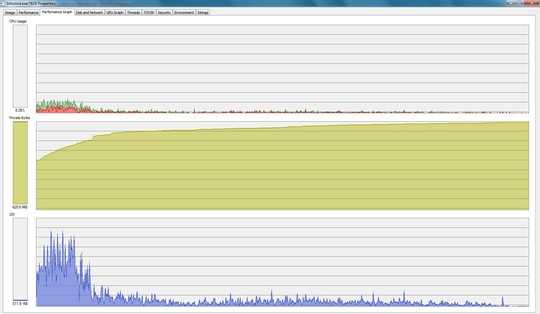
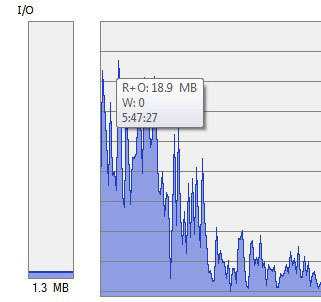
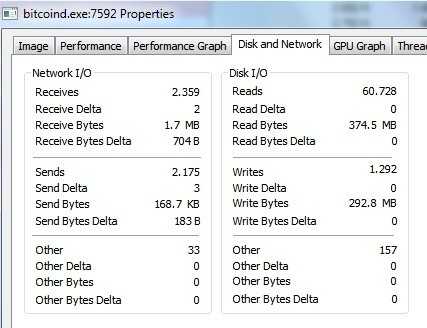
@Jannes I have added a few graphs from a full node to my answer. You say that our concerns about throughput are "nonsense", but I'm afraid numbers speak otherwise. SD's top model maxes at 30 MB/s but take a look at the second graph which is the node receiving a block, I/0 gets as high as 19 MB/s and this is just a random block in bitcoin's still-small blocks. So, in the end, I guess it all comes down to what we actually call a heavy duty I/O task. – George Kimionis – 2014-04-09T15:40:17.440
It should be
sudo apt-get install bitcoind. – ike – 2014-11-12T16:03:45.327@ike the packet name has changed name indeed since the time of the writing, updated my answer, thanks. – George Kimionis – 2014-11-12T19:08:46.097