The target section of the block header is called nBits in the code. nBits is a 32-bit compact encoding of a 256-bit target threshold. It works like scientific notation, except that it uses base-256 instead of base-10. For example, if nBits is equal to 0x181b8330, you would calculate it like this:
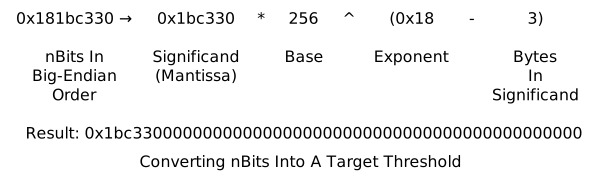
Or, more simply, you'd use the same shorthand you use with regular scientific notation:
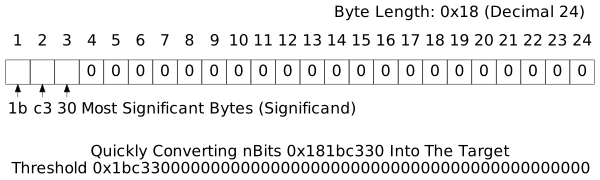
At a re-target point (every 2,016th block), Bitcoin Core adjusts nBits according to the rules described in this answer except that it is important to note that when difficulty changes by p percent, nBits is adjusted by the inverse (-p percent). That's because a lower target is harder to reach the way Bitcoin is implemented.
It's also important to note that you can't just adjust the exponent part of nBits in the obvious way because when Satoshi first wrote the code, he inherited from a signed type---so extra care must be taken not to create a negative nBits value. The Bitcoin.org Developer Reference has more details (but be careful, I haven't yet had an expert review that section).


It is not clear to me whether you are looking for a verbal explanation of the difficulty algorithm, the specific line of code where to find it, or a step-by-step explanation of the code. Perhaps you could edit your question in order to clarify. If you are asking for the first: possible duplicate of How is difficulty calculated?
– Murch – 2014-03-24T12:21:39.453Is difficulty the same thing as the target? – Dylan Katz – 2014-03-24T15:54:06.590
3
Difficulty is essentially the human readable representation of the target. See here: What is “difficulty” and how it relates to “target”?
– Murch – 2014-03-24T22:23:45.537